

FREE SHIPPING
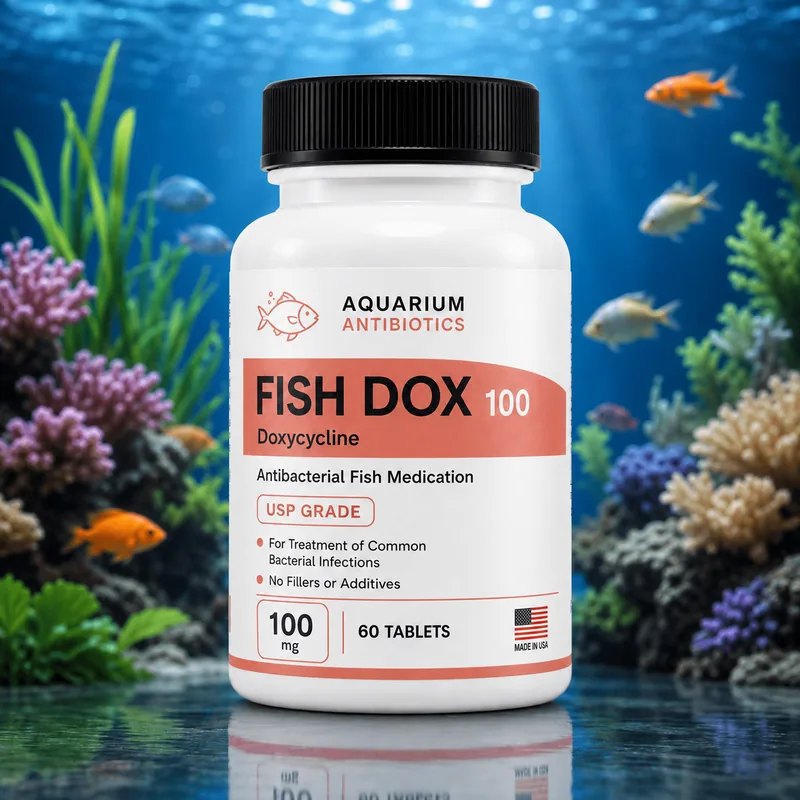
Fish Dox Tablets
$89.99
- Free shipping to any US address
- Buy more, save more: 5% off $150+, 10% off $300+, 15% off $500+
- Secure checkout: card, Apple Pay, Google Pay or PayPal
- All sales final · covered if damaged before delivery
- Shipped from the USA with tracking
For ornamental aquarium fish use only. Not for human use or for fish intended for food. Keep out of reach of children. Read the label and consult a veterinarian if you are unsure.
Keeping pet birds? Fish products are labeled for aquarium fish only. See our bird products.
Reviewed by Dr. Kayla Garcia and Dr. Erin Min, veterinarians at Los Feliz Veterinary Clinic
Fish Dox Tablets contain doxycycline, a tetracycline-class antibiotic. Doxycycline is a tetracycline that stops bacteria from making proteins they need to grow. It has a broad spectrum and is a long-standing favorite for systemic infections.
Spectrum: Broad-spectrum, covering many gram-positive and gram-negative bacteria.
Table of contents
- Introduction
- What is Fish Dox?
- Common fish diseases Fish Dox is used for
- How doxycycline works in an aquarium
- Things to know before you treat
- Fish Dox dosage and administration guide
- Tank preparation and water parameters
- Step-by-step treatment guide: using Fish Dox from start to finish
- Safety, side effects and precautions
- Storage and shelf life
- Fish Dox vs other aquarium antibiotics: which one should you choose?
- Compatibility and interactions
- Signs of recovery and when to seek veterinary help
- What Fish Dox does not treat
- Choosing a count, and Fish Dox vs other classes
- Regulations and responsible use
- Fish Dox Tablets FAQ
- Conclusion
- Recommended resources
Introduction
Not every bacterial infection announces itself at the fin edges. Some of the most dangerous ones work from the inside: a fish that goes quiet and stops eating, a belly that swells until the scales stand out, red streaks that creep through the fins, an eye that bulges with no injury to explain it. These systemic infections are harder to read than fin rot and harder to reach, because the bacteria are in the blood and organs rather than on the skin where a surface antibiotic can bathe them.
Fish Dox is the aquarium hobby's name for doxycycline tablets made for fish. It belongs to the tetracycline class, and it has held a place in the medicine cabinet for decades because its spectrum is broad enough to cover both gram-positive and gram-negative bacteria, and because it is absorbed and distributed through the body rather than acting only at the surface. This page covers what Fish Dox is, the conditions it is used for and the ones it is not, the label dose converted to common tank sizes, how to prepare the tank, a start-to-finish treatment walkthrough, the tetracycline quirks keepers learn the hard way, safety notes, how it compares with the other antibiotics we sell, and the questions keepers ask most.
Important: Fish Dox is made, labeled and sold for ornamental aquarium and pond fish only. It is not for human use and not for fish intended for food. Keep it out of reach of children. If you are unsure about the diagnosis, ask an aquatic veterinarian before treating.
What is Fish Dox?
Fish Dox is the hobby name for doxycycline tablets made for ornamental aquarium fish. Each tablet holds 100mg of doxycycline, a tetracycline-class antibiotic, that you dissolve in aquarium water to treat susceptible bacterial infections, especially the internal and systemic ones that a fin-and-skin antibiotic does not reach well. Doxycycline is bacteriostatic: it stops bacteria from multiplying and lets the fish's immune system clear the rest.
Doxycycline has a long record in the hobby because its spectrum is broad: it covers many gram-positive and gram-negative bacteria, which makes it a common choice when the exact bacteria are unknown or when a fish is sick on the inside rather than at the fin edges. The 100mg tablet is crushed and dissolved in a cup of tank water, then added so the fish takes it in steadily through the gills and skin. It is sold here in 30- and 60-tablet bottles, labeled for aquarium and pond fish only. It is not for human use and not for fish intended for food.
If you are not sure the problem is bacterial, read Do fish need antibiotics? first. Internal signs such as swelling and wasting have several possible causes, and only some of them are bacterial.
Product details at a glance
| Active ingredient | Doxycycline |
|---|---|
| Drug class | Tetracycline-class antibiotic |
| Available sizes | 100mg strength, 30 or 60 tablets per bottle |
| Formulation | Tablet; crush and dissolve in aquarium water before adding |
| Spectrum of activity | Broad-spectrum, covering many gram-positive and gram-negative bacteria. |
| Intended for | Ornamental aquarium fish only |
| Storage conditions | Cool, dry and dark, lid tightly closed; discard discolored tablets; check the expiration date |
| Shipping | Free, from the USA |
| Sold by | SourceMax Labs LLC |
Common fish diseases Fish Dox is used for
Keepers commonly use doxycycline for infections that have gone beyond the skin: systemic illness, dropsy with a bacterial cause, and cases where a first antibiotic did not help. Below are the conditions it is most often chosen for, and the ones where another class is usually the better start. Internal disease is hard to read from the outside, so if several fish are affected or a fish has stopped eating, ask an aquatic veterinarian.
Internal and systemic bacterial infections
A fish that is lethargic, off its food, pale or clamped with no obvious external sore may be fighting an infection inside. Doxycycline is absorbed from the water and distributed through the body, which is why keepers reach for a tetracycline when the problem is not confined to the fins or skin.
Dropsy with a bacterial cause
Swelling and scales standing out like a pinecone mean fluid is building up inside, often from a gram-negative infection affecting the kidneys. Dropsy is a symptom rather than one disease and outcomes vary, but when it is caught early a broad-spectrum tetracycline such as doxycycline or minocycline is one of the usual choices. The dropsy guide covers the supporting care that matters as much as the medication.
Red streaks and hemorrhagic septicemia
Red streaking in the fins, pinpoint bleeding under the skin and a listless fish point to bacteria in the bloodstream, very often gram-negative Aeromonas or Pseudomonas. Doxycycline's broad coverage makes it a common starting point here, with a fluoroquinolone such as Fish Flox as the usual alternative for fast, aggressive cases.
Mixed or unidentified infections
When a fish shows several signs at once, or when the bacteria could be gram-positive or gram-negative, keepers often choose doxycycline because it reaches both groups. It is the hobby's general-purpose antibiotic for cases that do not point clearly to one class.
Fin rot that did not respond to a penicillin-class antibiotic
If a course of Fish Mox or Fish Ceph has not stopped fin rot, the bacteria may be gram-negative or resistant to beta-lactams. Switching to a different class, such as doxycycline, is the usual next step; see the fin rot treatment guide. For ordinary, slow fin rot the beta-lactams remain the gentler first choice.
Popeye linked to infection
One or both eyes bulging, sometimes cloudy, is often bacterial when it affects one eye after an injury or appears with other signs of illness. A systemic antibiotic such as doxycycline is commonly used alongside clean water; the popeye guide explains how to tell injury from infection and from water-quality causes.
Bacterial gill disease
Rapid breathing, gasping at the surface, flared gill covers and mucus on the gill filaments can be bacterial, parasitic or chemical (ammonia and nitrite burns). Test the water first. Dissolved doxycycline reaches a confirmed bacterial gill infection through the constant contact of the gills with medicated water; flukes and other gill parasites, a frequent cause of the same signs, need a different treatment altogether.
How doxycycline works in an aquarium
Doxycycline is a tetracycline. It enters bacterial cells and blocks the ribosomes they use to build proteins, so the bacteria stop growing and multiplying. It is bacteriostatic rather than bactericidal: it halts the infection and relies on the fish's own immune system to clear the remaining bacteria. That is one reason supporting care, clean warm water and low stress, matters so much with this class, and why a full course matters even more than with a killing drug.
Its spectrum is broad, covering many gram-positive and gram-negative bacteria, because the ribosome it targets is common to both groups and the drug crosses the gram-negative outer membrane well. It does nothing against parasites, fungi or viruses, and it will not correct the water conditions that usually allowed the infection to start.
How it reaches the fish: dissolved in the water, doxycycline is taken up through the gills and skin and spreads through the body, which is what makes it useful for internal disease. A few practical points keepers learn with tetracyclines: the medication is sensitive to light, so keeping the tank lights low and the room dim during treatment helps each dose last; it can tint the water a yellow-brown shade that clears with water changes; and it binds to calcium and other minerals, so in very hard water or marine tanks it is generally considered less effective. Tetracyclines are also harder on the beneficial filter bacteria than most classes, so a separate hospital tank is strongly preferred.
Things to know before you treat
- Tetracyclines can affect biofilter bacteria, so treat in a hospital tank when possible.
- Not effective against parasites or fungi.
- Keep medicated water out of reach of children and other animals.
Fish Dox dosage and administration guide
Correct dosing matters in both directions. Too little fails to halt the infection and selects for resistant bacteria; too much stresses the fish and crashes the filter. Everything below follows the directions printed on the label: one 100mg tablet per 10 gallons of aquarium water, every 24 hours. Dose for the actual water volume after subtracting gravel and decor (a "55-gallon" tank often holds 45 gallons), and never exceed 10 days of continuous treatment.
Directions for use (from the label)
Directions as printed on the product label, for ornamental aquarium fish only. Remove activated carbon from the filter before treatment: carbon absorbs the medication and makes it ineffective.
- Determine your dose: use one 100mg tablet per 10 gallons of aquarium water.
- Dissolve the tablet in a small amount of aquarium water before adding to the tank. Stir until fully dissolved.
- Add directly to your aquarium, pond, or hospital/quarantine tank.
- Repeat every 24 hours for 5–10 days. Do not exceed 10 days of continuous treatment.
- Perform a 25% water change each day before re-dosing to maintain water quality and reduce antibiotic buildup.
Standard dosage chart
| Strength | Water volume | Frequency | Duration |
|---|---|---|---|
| 100mg tablet | 10 gallons | Every 24 hours | 5 to 10 days (never more than 10) |
Dose by tank size
| Water volume | 100mg tablets |
|---|---|
| 10 gallons | 1 tablet |
| 20 gallons | 2 tablets |
| 30 gallons | 3 tablets |
| 50 gallons | 5 tablets |
| 100 gallons | 10 tablets |
Tablets dissolve more slowly than capsule powder, so crush the tablet and stir it in a cup of tank water until the liquid is cloudy and even before adding it. For ornamental aquarium fish only; not for human use.
Freshwater vs saltwater
The label directions are the same for freshwater and marine tanks, but doxycycline is the one antibiotic here where the water itself matters. Tetracyclines bind to calcium and magnesium, and marine water and very hard freshwater are rich in both, so many marine keepers consider doxycycline less reliable in a reef-salinity quarantine tank and choose another class. Reef and planted displays also hold corals, shrimp, snails and plants that were never part of the product's testing, and marine systems run protein skimmers and UV units that strip medication from the water. If you do use it in saltwater, treat in a bare quarantine tank with the skimmer and UV off, the carbon out and the lights dimmed, and keep the display untouched.
Tank preparation and water parameters
Skipping preparation is the most common reason an antibiotic course fails. Ten minutes before the first dose makes the difference, and with a tetracycline there is one extra step: the lights.
- Remove activated carbon and other chemical media (carbon, Purigen, zeolite, resin pads) from every filter. They absorb the doxycycline before it can act.
- Turn off UV sterilizers and protein skimmers for the duration of the course, and keep the tank lights off or very low; doxycycline breaks down in light, and a bright tank wastes each dose.
- Do a 25% water change before the first dose to lower the organic load the drug has to compete with, then follow the label's daily 25% change before each re-dose.
- Test and stabilise the water: ammonia and nitrite at zero, nitrate low, temperature steady and appropriate for the species. Internal signs such as swelling and lethargy are often water-quality problems before they are bacterial ones.
- Note your water hardness. Very hard, mineral-rich water ties up tetracyclines; if yours is, a hospital tank filled with softer water, or a different class, may serve better. Avoid large chemistry changes mid-course.
- Set up a hospital tank if you can: a bare-bottom 10- to 20-gallon tank with a heater, an air stone and a seasoned sponge filter. It isolates the sick fish, uses a fraction of the medication, keeps the tint and dim lighting out of the display, and protects the display's plants, invertebrates and biofilter. See how to set up a hospital tank.
Step-by-step treatment guide: using Fish Dox from start to finish
The label gives the dose; this is how keepers run the whole course, from the first sign of trouble to the day the fish goes back to the display.
1. Identify the problem
Confirm the signs point to a bacterial infection, and especially an internal one: lethargy and refusal of food with no external sore, pinecone swelling, red streaks, a bulging eye, or fin rot that has already beaten a beta-lactam. White cotton-like tufts suggest fungus, salt-grain dots suggest ich, and white stringy waste suggests gut parasites; none of these responds to doxycycline. Test the water: ammonia or nitrite above zero is a problem to fix before, or instead of, medicating.
2. Prepare the treatment environment
Move the fish to the hospital tank, or prepare the display as described above: carbon out, UV and skimmer off, lights off or dim, heater and air stone running, a 25% water change done. A seasoned sponge filter keeps some biological filtration going even as the antibiotic works on it.
3. Measure the water and calculate the dose
Work out the real water volume (length × width × height in inches ÷ 231 gives gallons, then subtract for substrate and decor). Use one 100mg tablet per 10 gallons, as the label directs. For an awkward volume, round the volume down to the nearest 10 gallons rather than rounding a dose up.
4. Dissolve and add the medication
Crush the tablet, stir it into a cup of tank water until the liquid is evenly cloudy, and pour it slowly across the surface or near the filter outflow so it spreads. Undissolved fragments settle on the substrate instead of treating the water. Expect a slight yellow tint in the tank; it is normal.
5. Run the daily cycle
Every 24 hours, change about 25% of the water as the label directs, then add the full dose again. Dose at the same time each day, keep the temperature constant and the lights low, and feed lightly, removing anything uneaten so waste does not raise ammonia in a small tank.
6. Monitor and assess
Watch appetite, breathing rate, swelling, color and any sore or streak, and write it down. Because doxycycline halts bacteria rather than killing them, improvement can be gradual; the fish should stop getting worse within 2 to 3 days. If after 4 to 5 days of correct dosing nothing has changed, doxycycline is probably the wrong tool (see "when to switch" below).
7. Complete the course
Keep dosing for the full course even when the fish looks better after a few days; with a bacteriostatic drug a shortened course lets the surviving bacteria regrow. Stop at 10 days at most, as the label says.
8. Recovery after treatment
After the last dose, do a larger water change and put fresh activated carbon back in the filter for a few days to clear residues and the tint. Test ammonia and nitrite daily for a week, since tetracyclines are hard on the biofilter; a bottled nitrifying-bacteria product can help it recover. Keep the fish in quarantine until it has eaten normally for a week, then move it back to the display and watch for relapse.
See water quality during treatment for the daily testing routine.
Safety, side effects and precautions
Used as directed, doxycycline is well tolerated by most fish, but tetracyclines ask a little more of the keeper than the beta-lactams do, and every antibiotic carries risks worth understanding before the first dose.
Effects on beneficial bacteria
Tetracyclines are harder on the nitrifying bacteria that process ammonia and nitrite than most classes. Treat in a hospital tank where you can. If you treat the display, test ammonia and nitrite every day during and after the course, change water when either rises, and expect to re-seed the filter afterward.
Invertebrates, corals and plants
Fish Dox is made for fish and has not been tested on shrimp, snails, crabs or corals. Plants usually tolerate the drug itself but dislike the dim lighting a course calls for, and a crashed biofilter harms everything in the tank. Do not treat a community tank that holds sensitive invertebrates; use a dedicated hospital tank.
Scaleless and sensitive species
Loaches, catfish, eels and other scaleless fish, and delicate species generally, can react differently to medications. Doxycycline is usually tolerated, but watch these fish closely, keep aeration high, and stop and change water if they show distress.
Light, tint and hard water
Doxycycline degrades in light, tints the water yellow-brown, and binds to calcium and magnesium in hard or marine water. None of these harms the fish, but each can quietly reduce the dose the fish actually receives. Keep the lights low, accept the tint, and consider another class if your water is very hard.
Antibiotic resistance
Underdosing, stopping early, and treating problems that are not bacterial all breed resistant bacteria that no amount of doxycycline will touch next time. Dose per label, finish the course, and reserve antibiotics for confirmed or strongly suspected bacterial disease.
Storage and shelf life
Keep the bottle tightly closed in a cool, dry, dark place. Doxycycline is sensitive to both moisture and light: tablets that have discolored, darkened or crumbled have lost strength and should not be used. A bathroom cabinet is too damp and a windowsill too bright. Keep the tablets in their original labeled bottle so the strength and expiration date stay with them.
Check the expiration date on the label before each course and do not use tablets past it. Aged tetracyclines are best discarded rather than used: an expired tablet may deliver less than the label dose, which is the under-dosing that breeds resistance. Dispose of expired or unwanted tablets through a pharmacy or household-chemical take-back scheme rather than the bin, and pour unused treated water down the drain, never into ponds or waterways.
Wash hands after dosing and keep the bottle and medicated water out of reach of children and other pets. Medicated water can stain light-colored surfaces and clothing, so wipe up spills promptly.
Fish Dox vs other aquarium antibiotics: which one should you choose?
Fish Dox is the hobby's general-purpose choice for internal illness and unclear cases, but it is not the only tool. The table compares the antibiotics we sell so you can match the class to the problem; each product page carries its own full guide.
| Product | Active ingredient | Spectrum | Commonly chosen for | Notes |
|---|---|---|---|---|
| Fish Dox | Doxycycline | Broad tetracycline; gram-positive and gram-negative | Internal and systemic infections; dropsy with a bacterial cause; mixed or unknown infections | Harder on biofilters; light-sensitive; weaker in hard water |
| Fish Mox | Amoxicillin | Broad; mainly gram-positive plus some gram-negative | Fin rot, ulcers, wounds, mouth and skin infections | The hobby's most common first choice for external infections; gentle on fish |
| Fish Ceph | Cephalexin | Gram-positive focused | Skin, fin and wound infections; a switch when amoxicillin has not helped | Stable against some enzymes that break penicillins down |
| Fish Flox | Ciprofloxacin | Broad; strong gram-negative | Columnaris, septicemia, aggressive ulcers | Reserve for serious or unresponsive cases |
| Fish Minocycline | Minocycline | Broad tetracycline | Dropsy, popeye, internal gram-negative infections | Closely related to doxycycline; the tetracycline many keepers prefer for dropsy |
| Fish Sulfa | Sulfamethoxazole + trimethoprim | Broad combination | Unclear or mixed infections; a backup class | Sulfa allergy: handle with gloves |
General guidance: for fin rot and surface wounds, start with a beta-lactam such as Fish Mox; it is gentler on the filter. Fish Dox earns its place when the illness is internal, when the bacteria could be gram-negative, or when a first class has failed. For fast, aggressive gram-negative infections such as columnaris and severe septicemia, a fluoroquinolone such as Fish Flox is usually chosen instead. The antibiotic comparison guide goes deeper.
Compatibility and interactions
Mixing aquarium treatments without guidance makes it impossible to tell what is helping and can harm the fish. The general rules keepers follow:
- Fish Dox + metronidazole (Fish Zole): the two cover different organisms (aerobic bacteria versus anaerobes and protozoa), so keepers sometimes run them together for a fish with both a systemic infection and gut parasites. Do so only when a veterinarian or an experienced keeper you trust directs it.
- Fish Dox + another antibiotic (Fish Mox, Fish Ceph, Fish Flox): avoid. Overlapping antibiotics hit the biofilter harder and rarely improve the outcome. Switch classes when one fails; do not stack them.
- Fish Dox + aquarium salt: generally compatible. A low dose of aquarium salt, used as its own label directs and only with salt-tolerant species, can ease osmotic stress; it does not change the medication, though it adds slightly to the mineral load.
- Fish Dox + water conditioners and buffers: standard dechlorinators are fine for the daily water changes. Avoid adding calcium or magnesium supplements and mineral buffers during the course, since tetracyclines bind to them, and skip additives with herbal extracts or "slime coat" formulas.
- Fish Dox + antiparasitic or antifungal products: do not combine. Treat one problem at a time, starting with whichever is most immediately dangerous.
- Carbon, Purigen, UV, skimmers, bright light: all remove or degrade the medication. Out or off for the whole course.
Signs of recovery and when to seek veterinary help
What improvement looks like
Because doxycycline halts bacteria rather than killing them outright, improvement can be a little slower to show than with a bactericidal drug. The first good sign is that the fish stops getting worse within 2 to 3 days:
- Red streaks stop spreading and swelling stops increasing
- The fish spends less time hiding or clamped and starts to move with the group
- Appetite returns, the clearest signal of all
- With dropsy, scales begin to settle back and swelling eases over the following week; advanced dropsy often does not recover whatever is used
- Breathing and gill movement return to normal, and a bulging eye begins to recede
When to consult an aquatic veterinarian
Seek professional help when:
- Nothing has changed after 4 to 5 days of correct dosing, or the fish is still declining
- The fish is gasping, has stopped eating entirely, or more fish are falling ill
- You cannot tell whether the problem is bacterial, parasitic, fungal or environmental
- Dropsy or popeye keeps coming back after apparently successful courses
Common reasons doxycycline fails: the bacteria are resistant to tetracyclines, hard or marine water has tied up the medication, the problem is parasitic, fungal or environmental, or the fish was already too far gone. Keepers then move to a different class such as a fluoroquinolone rather than repeating the same one; the antibiotic comparison explains the choices. A veterinarian can culture a sample and tell you what will actually work; the American Veterinary Medical Association and the World Aquatic Veterinary Medical Association both list aquatic practitioners.
What Fish Dox does not treat
Doxycycline acts only on bacteria. Used for anything else it costs days while the real problem advances.
- Ich (white spot) and velvet: external parasites that need heat with salt or a copper-based product; see the ich and velvet guide.
- Internal parasites and hole-in-the-head: white stringy waste, wasting and head pitting are usually treated with metronidazole (Fish Zole); see bloat and internal parasites. Bloat from parasites and dropsy from bacteria can look alike.
- True fungus: fluffy cotton-like tufts on dead tissue or eggs need an antifungal such as fluconazole, not an antibiotic. See columnaris vs fungus, since many "fungus" cases are bacterial columnaris.
- Swim bladder trouble, constipation bloat, ammonia burns, temperature shock: environmental and dietary problems that no antibiotic can fix.
- Viral growths such as lymphocystis, which resolve on their own with good care.
Choosing a count, and Fish Dox vs other classes
30 vs 60 tablets: the same 100mg tablet in two bottle sizes. One full course on a 20-gallon hospital tank uses 10 to 20 tablets, so the 30-count bottle covers one treatment with a little to spare. Keepers with several tanks, larger fish such as goldfish and cichlids that tend to need systemic treatment, or a quarantine routine for new fish usually choose the 60-count bottle, which costs less per tablet. Orders of $150 or more also qualify for our automatic bulk discount.
Fish Dox or something else? For fin rot and surface wounds, a beta-lactam such as Fish Mox is the more common first choice and is gentler on the filter. Doxycycline earns its place when the illness is internal, when the bacteria could be gram-negative, or when a first class has failed. For fast, aggressive gram-negative infections such as columnaris and severe septicemia, a fluoroquinolone such as Fish Flox is usually chosen instead. Fish Minocycline is the closely related tetracycline many keepers prefer specifically for dropsy and popeye.
Regulations and responsible use
Fish Dox is made, labeled and sold for ornamental (non-food) aquarium fish. It has not been evaluated or approved for human use, and it must never be used on fish raised for food, where drug residues are a public-health matter. The U.S. Food and Drug Administration explains the position of ornamental-fish drugs in its article Ornamental Fish Drugs and You.
Rules for animal medicines differ by country and change over time. Outside the United States, access to veterinary antibiotics is often restricted and may require a prescription, and importing them can be unlawful; we ship within the US only. Antibiotic resistance is a shared concern, which is why responsible use matters: diagnose before you dose, use the label amount for the full course, never medicate healthy fish as a precaution, and dispose of leftovers properly.
Fish Dox Tablets FAQ
How much Fish Dox Tablets do I use per gallon of aquarium water?
Determine your dose: use one 100mg tablet per 10 gallons of aquarium water. Repeat every 24 hours for 5–10 days. Do not exceed 10 days of continuous treatment. For ornamental aquarium fish only; not for human use.
What is in Fish Dox Tablets?
Fish Dox Tablets contain doxycycline, a tetracycline-class antibiotic. Available sizes: 100mg strength, 30 or 60 tablets per bottle. Broad-spectrum, covering many gram-positive and gram-negative bacteria.
What is doxycycline used for in an aquarium?
Keepers commonly use it for bacterial problems such as internal and systemic bacterial infections, dropsy-type conditions caused by bacteria, mixed bacterial problems. It does not treat parasites or true fungus. Our antibiotic comparison guide explains which class suits which problem.
Is Fish Dox Tablets for humans?
No. It is labeled for ornamental aquarium fish only and is not for human use or for fish intended for food. Keep out of reach of children.
What is the correct dose of Fish Dox for a 20-gallon tank?
Two 100mg tablets per 20 gallons of actual water volume, repeated every 24 hours for 5 to 10 days with a 25% water change before each dose, as the label directs. Measure the real volume: a 20-gallon tank with gravel and decor usually holds 16 to 18 gallons, so one 10-gallon dose may be closer to right.
How long does Fish Dox take to work?
Doxycycline stops bacteria from multiplying rather than killing them outright, so improvement can be gradual. Keepers usually see the fish stop getting worse within 2 to 3 days and appetite return after that. If there is no change after 4 to 5 days of correct dosing, the bacteria are probably not susceptible to doxycycline.
Why does Fish Dox turn the water yellow?
Tetracyclines tint water a yellow-brown shade as they dissolve, and it darkens as the medication breaks down in light. It is normal and clears with the daily water changes and a few days of fresh carbon after the course. Keep the tank lights low during treatment to slow the breakdown.
Can I use Fish Dox in a saltwater tank?
The label directions are the same for marine tanks, but tetracyclines bind to calcium and magnesium, and marine water is rich in both, so many marine keepers consider doxycycline less reliable there and choose another class. If you do use it, treat in a quarantine tank with the skimmer off, carbon removed and the lights dimmed.
Does Fish Dox treat dropsy?
When dropsy is caused by a bacterial infection and is caught early, a broad-spectrum tetracycline such as doxycycline is one of the usual choices, along with clean warm water and low stress. Dropsy is a symptom of organ trouble rather than one disease, so advanced cases often do not recover whatever is used.
Should I turn the lights off when treating with Fish Dox?
Yes, or keep them very low. Doxycycline degrades in light, so dim lighting and shading the tank help each dose last the full 24 hours. The fish do not mind the dark while recovering.
Can I use Fish Dox in my main tank?
You can, but tetracyclines are harder on the beneficial filter bacteria than most classes, so the tank is likely to lose its cycle and ammonia can spike. A small hospital tank uses far less medication and protects the display aquarium. If you must treat the main tank, remove carbon and test ammonia and nitrite daily.
Will Fish Dox harm the beneficial bacteria in my filter?
Very likely, more so than the beta-lactams. Doxycycline does not distinguish nitrifying bacteria from the ones causing disease, so ammonia or nitrite often rise during a course. Test daily, change water when they climb, and re-seed the filter with a bottled nitrifying-bacteria product afterward.
Is Fish Dox safe for shrimp, snails and plants?
Doxycycline is generally considered gentler on plants and invertebrates than copper or dye-based treatments, but it has not been tested on them, it disturbs filter bacteria and tints the water, and some plants dislike the dim lighting a course calls for. Treat in a hospital tank where possible.
Does hard water make Fish Dox less effective?
Tetracyclines bind to calcium and magnesium, so in very hard or mineral-rich water less of each dose stays available to the fish. Keepers with hard tap water often fill the hospital tank with softer water for the course, or choose a different class. Do not try to compensate by exceeding the label dose.
How should I prepare my aquarium before using Fish Dox?
Remove activated carbon and other chemical media, switch off UV and skimmers, turn the lights off or very low, do a 25% water change, and make sure ammonia and nitrite read zero with a steady temperature. Set up a hospital tank if you can. Then dose for the actual water volume.
What should I do if Fish Dox does not improve my fish?
If there is no change after 4 to 5 days of correct dosing, stop and reconsider. The bacteria may be resistant to tetracyclines, hard water may have tied up the medication, or the problem may not be bacterial. A fluoroquinolone such as ciprofloxacin is the usual next class; an aquatic veterinarian can culture a sample and tell you what will work.
Can I combine Fish Dox with other fish medications?
Avoid combining it with other antibiotics or with antiparasitic and antifungal products unless a veterinarian directs it. It is generally compatible with standard dechlorinators and with aquarium salt used as its own label directs; avoid mineral buffers and calcium supplements during the course.
Can I feed the fish while treating with Fish Dox?
Yes, lightly. Eating is the best sign of recovery. Feed small amounts once a day and remove leftovers, since waste raises ammonia quickly in a small hospital tank. A fish that will not eat for several days should be seen by a veterinarian.
Is shipping really free?
Yes. Shipping is free to any US address, and tracking is emailed when your order ships.
How do I pay?
Checkout accepts major credit and debit cards and digital wallets such as Apple Pay and Google Pay, through a secure payment page.
Conclusion
Fish Dox is the tetracycline keepers reach for when the trouble is inside the fish: systemic infections, early dropsy, red streaks, popeye, and the cases where a first antibiotic class has not helped. Its broad spectrum and body-wide distribution make it the hobby's general-purpose choice for unclear cases, and used responsibly, with a careful diagnosis, the label dose for the actual water volume, dim lights, a full course and a prepared hospital tank, it gives an ornamental fish a good chance of recovery from an infection a surface antibiotic could not reach.
It is still a tool, not a substitute for husbandry. Stable water, quarantine for new arrivals, sensible stocking and a varied diet prevent most of the infections an antibiotic would otherwise have to treat, and with a bacteriostatic drug the fish's own strength does half the work. Keep a bottle on hand so you can act on the first day a fish goes quiet, and keep the water clean so that day comes rarely.
Recommended resources
On this site
- Dropsy in Fish: Signs, Causes and Treatment Options
- Popeye (Pop-Eye) in Fish: Causes and Treatment
- Fish Antibiotics Compared: Which Class Treats What
- Do Fish Need Antibiotics? Signs of a Bacterial Infection
- How to Set Up a Fish Hospital Tank
- Water Quality During Fish Treatment
- Fish Minocycline: the related tetracycline for dropsy and popeye
- Fish Flox (ciprofloxacin): for columnaris and septicemia
External resources
- FDA: Ornamental Fish Drugs and You
- American Veterinary Medical Association
- World Aquatic Veterinary Medical Association
- Merck Veterinary Manual
This page is educational and does not replace veterinary advice. Fish Dox and every product discussed here are for ornamental aquarium fish only; they are not for human use and not for fish intended for food. Consult a qualified aquatic veterinarian for diagnosis and treatment decisions.
Customer reviews
You may also need


