

FREE SHIPPING
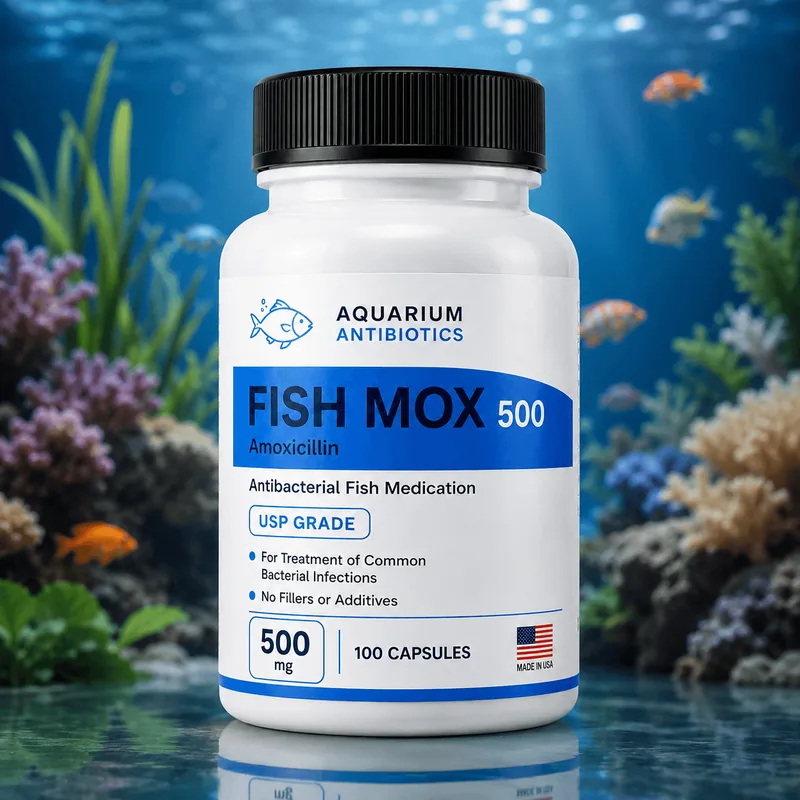
Fish Mox Capsules
$49.99$57.40Save $7.41
- Free shipping to any US address
- Buy more, save more: 5% off $150+, 10% off $300+, 15% off $500+
- Secure checkout: card, Apple Pay, Google Pay or PayPal
- All sales final · covered if damaged before delivery
- Shipped from the USA with tracking
For ornamental aquarium fish use only. Not for human use or for fish intended for food. Keep out of reach of children. Read the label and consult a veterinarian if you are unsure.
Keeping pet birds? Fish products are labeled for aquarium fish only. See our bird products.
Reviewed by Dr. Kayla Garcia and Dr. Erin Min, veterinarians at Los Feliz Veterinary Clinic
Fish Mox Capsules contain amoxicillin, a penicillin-class (aminopenicillin) antibiotic. Amoxicillin is a beta-lactam antibiotic that kills bacteria by blocking construction of their cell walls. It is one of the most commonly used antibiotics in the aquarium hobby.
Spectrum: Mainly gram-positive bacteria, plus some gram-negative species. It is not active against parasites, viruses or fungi.
Table of contents
- Introduction
- What is Fish Mox?
- Common fish diseases Fish Mox is used for
- How amoxicillin works in an aquarium
- Things to know before you treat
- Fish Mox dosage and administration guide
- Tank preparation and water parameters
- Step-by-step treatment guide: using Fish Mox from start to finish
- Safety, side effects and precautions
- Storage and shelf life
- Fish Mox vs other aquarium antibiotics: which one should you choose?
- Compatibility and interactions
- Signs of recovery and when to seek veterinary help
- What Fish Mox does not treat
- Choosing a strength and count
- Regulations and responsible use
- Fish Mox Capsules FAQ
- Conclusion
- Recommended resources
Introduction
Bacterial infections are one of the leading causes of loss in ornamental aquarium fish. Whether you keep a planted community tank of tetras and corydoras, a goldfish pond, or a marine quarantine system, an outbreak of fin rot, ulcers or septicemia can move from one fish to the whole tank in days. Recognising a bacterial problem early and treating it with the right antibiotic, at the label dose and for the full course, is usually what separates a recovery from a loss.
Fish Mox is the aquarium hobby's long-standing name for amoxicillin capsules made for fish. It has sat in fishkeepers' medicine cabinets for decades because it is forgiving, dissolves cleanly, and works on the gram-positive bacteria behind the most common fin, skin and wound infections. This page covers everything you need before you dose: what Fish Mox is, which conditions it is used for and which it is not, the label dose converted to common tank sizes, how to prepare the tank, a start-to-finish treatment walkthrough, safety notes, how it compares with the other antibiotics we sell, and the questions keepers ask most.
Important: Fish Mox is made, labeled and sold for ornamental aquarium and pond fish only. It is not for human use and not for fish intended for food. Keep it out of reach of children. If you are unsure about the diagnosis, ask an aquatic veterinarian before treating.
What is Fish Mox?
Fish Mox is the hobby name for amoxicillin capsules made for ornamental aquarium fish. Each capsule holds a measured amount of amoxicillin trihydrate, 250mg or 500mg, that you dissolve in aquarium water to treat susceptible bacterial infections. Amoxicillin belongs to the beta-lactam family within the wider penicillin class, and it is bactericidal: it kills susceptible bacteria rather than only slowing them down. The 500mg capsule is often called Fish Mox Forte; it is the same medication with twice the amount per capsule (see Fish Mox vs Fish Mox Forte).
The two strengths let you scale a course from a 10-gallon hospital tank to a large community aquarium or pond. The capsules are designed to be pulled apart so the powder can be dissolved in a cup of tank water and spread evenly, which gives the fish steady exposure through the gills and skin. It is sold here in 30- and 100-capsule bottles, labeled for aquarium and pond fish only. It is not for human use and not for fish intended for food.
If you are new to fish antibiotics, start with Do fish need antibiotics? and What is Fish Mox? Many problems that look like infection are water-quality problems first.
Product details at a glance
| Active ingredient | Amoxicillin |
|---|---|
| Drug class | Penicillin-class (aminopenicillin) antibiotic |
| Available sizes | 250mg and 500mg strengths, 30 or 100 capsules per bottle |
| Formulation | Pull-apart capsule; the powder dissolves in aquarium water |
| Spectrum of activity | Mainly gram-positive bacteria, plus some gram-negative species. It is not active against parasites, viruses or fungi. |
| Intended for | Ornamental aquarium fish only |
| Storage conditions | Cool, dry, out of sunlight, lid tightly closed; check the expiration date |
| Shipping | Free, from the USA |
| Sold by | SourceMax Labs LLC |
Common fish diseases Fish Mox is used for
Keepers reach for amoxicillin when a fish shows signs of a bacterial infection on the fins, skin or mouth. Below are the conditions it is most commonly used for, and the cases where a different class is usually the better first choice. Diagnosis by sight is never certain, so if several fish are affected or a fish stops eating, ask an aquatic veterinarian.
Fin rot and tail rot
The most common reason people buy Fish Mox. Fin edges turn ragged, milky or dark, and the damage creeps toward the body; the usual culprits are Aeromonas, Pseudomonas and Flavobacterium species that take advantage of poor water or a torn fin. Early fin rot often clears with clean water alone; when it keeps spreading despite good water, a course of amoxicillin in a hospital tank is the usual next step, and it halts the bacteria so the fin tissue can regrow. Read the fin rot treatment guide for how to tell early from advanced cases.
Bacterial ulcers, sores and body wounds
Open red sores, pale patches that turn into craters, or wounds from fighting and netting that will not heal. Ulcers are often driven by Aeromonas hydrophila in freshwater and Vibrio species in marine tanks; left alone they deepen, invite fungus and can kill. Amoxicillin is used to stop infection from taking hold in the damaged tissue while the fish heals in clean, well-aerated water.
Mouth rot and skin infections
Swollen, eroded or whitened lips and patchy skin infections respond to amoxicillin when the bacteria are gram-positive. Note that a cottony or saddle-shaped white patch is often columnaris, a fast gram-negative infection for which a fluoroquinolone such as Fish Flox is usually chosen instead. Compare the two in columnaris vs fungus.
Secondary infections after injury, shipping or handling
New arrivals and fish that have been moved, netted or bullied often pick up bacterial infections through damaged slime coat and skin. A short amoxicillin course in the quarantine tank is a common precaution once an infection is actually visible; it is not a substitute for quarantine itself, and dosing healthy fish "just in case" only breeds resistance.
Bacterial gill disease
Rapid breathing, gasping at the surface, flared gill covers and mucus on the gill filaments can be bacterial, parasitic or chemical (ammonia and nitrite burns). Test the water first. Because the gills sit in constant contact with medicated water, dissolved amoxicillin reaches a confirmed bacterial gill infection efficiently; flukes and other gill parasites, a frequent cause of the same signs, need a different treatment altogether.
Red streaks and hemorrhagic septicemia
Red streaking in the fins or body and pinpoint bleeding under the skin point to a systemic infection, very often gram-negative (Aeromonas, Pseudomonas). Amoxicillin covers only some of these bacteria, so keepers more often start with a broad-spectrum tetracycline such as Fish Dox or a fluoroquinolone, and keep amoxicillin for gram-positive cases or for a fish that has responded to it before.
Dropsy and popeye
Dropsy (pinecone scales, swelling) and popeye are signs of internal trouble, usually gram-negative and often kidney-related. Amoxicillin is not the first choice here; see the dropsy guide and popeye guide, which explain why a tetracycline such as minocycline or doxycycline is more commonly used, and why early action matters more than the choice of drug.
How amoxicillin works in an aquarium
Amoxicillin is a beta-lactam antibiotic. It blocks the enzymes bacteria use to build peptidoglycan, the mesh that gives a bacterial cell wall its strength, so susceptible bacteria rupture as they try to grow and divide. That makes it bactericidal (it kills bacteria rather than only slowing them), and it is why the full course matters: stopping early leaves the hardiest survivors behind.
The mechanism works best on gram-positive bacteria, whose thick cell walls depend on that mesh. Gram-negative species carry an extra outer membrane that limits how much drug gets through, which is why amoxicillin reaches some of them (Aeromonas among them, in part) but is not the first pick for columnaris or septicemia.
How it reaches the fish: dissolved in the water, the drug is absorbed through the gills and, to a lesser degree, the skin, and it bathes external wounds directly. That steady exposure is the point of water-borne treatment, and it is why it is the normal route for fish that have stopped eating. Amoxicillin has no effect on parasites, fungi or viruses, and it will not fix the water-quality problem that usually let the infection start. Because it also kills the beneficial nitrifying bacteria in a filter, treating in a separate hospital tank protects the main aquarium's cycle.
Things to know before you treat
- Beta-lactams can be broken down by some resistant bacteria; if a fish does not improve, a different class is usually the next step.
- People with a penicillin allergy should avoid handling the capsules or treated water without gloves.
- Antibiotics can harm the beneficial bacteria in a biofilter, so treating in a hospital tank protects the main aquarium.
Fish Mox dosage and administration guide
Correct dosing matters in both directions. Too little fails to control the infection and selects for resistant bacteria; too much stresses the fish and crashes the filter. Everything below follows the directions printed on the label. Dose for the actual water volume (a "55-gallon" tank with gravel and decor often holds 45 gallons), and never exceed 10 days of continuous treatment.
Directions for use (from the label)
Directions as printed on the product label, for ornamental aquarium fish only. Remove activated carbon from the filter before treatment: carbon absorbs the medication and makes it ineffective.
- Determine your dose: use one 250mg capsule per 10 gallons of water, or one 500mg capsule per 20 gallons of water.
- Dissolve the capsule in a small amount of aquarium water before adding to the tank. Stir until fully dissolved.
- Add directly to your aquarium, pond, or hospital/quarantine tank.
- Repeat every 24 hours for 5–10 days. Do not exceed 10 days of continuous treatment.
- Perform a 25% water change each day before re-dosing to maintain water quality and reduce antibiotic buildup.
Standard dosage chart
| Strength | Water volume | Frequency | Duration |
|---|---|---|---|
| 250mg capsule | 10 gallons | Every 24 hours | 5 to 10 days (never more than 10) |
| 500mg capsule | 20 gallons | Every 24 hours | 5 to 10 days (never more than 10) |
Dose by tank size
| Water volume | 250mg capsules | 500mg capsules |
|---|---|---|
| 10 gallons | 1 capsule | — |
| 20 gallons | 2 capsules | 1 capsule |
| 40 gallons | 4 capsules | 2 capsules |
| 60 gallons | 6 capsules | 3 capsules |
| 100 gallons | 10 capsules | 5 capsules |
"—" means that strength does not divide evenly into the volume; use the other strength. Capsules are not easily split, so for a small hospital tank the 250mg strength gives finer control. For ornamental aquarium fish only; not for human use.
Freshwater vs saltwater
Fish Mox dissolves and works in both freshwater and marine water, and the label directions are the same for both. The difference is what else lives in the tank: reef and planted displays hold corals, shrimp, snails and plants that were never part of the product's testing, and marine systems run protein skimmers and UV units that strip medication from the water. Treat marine fish in a bare quarantine tank with the skimmer off and the carbon out, and keep the display untouched.
Tank preparation and water parameters
Skipping preparation is the most common reason an antibiotic course fails. Ten minutes before the first dose makes the difference.
- Remove activated carbon and other chemical media (carbon, Purigen, zeolite, resin pads) from every filter. They absorb the amoxicillin before it can act.
- Turn off UV sterilizers and protein skimmers for the duration of the course; both reduce the medication in the water column.
- Do a 25% water change before the first dose to lower the organic load the drug has to compete with, then follow the label's daily 25% change before each re-dose.
- Test and stabilise the water: ammonia and nitrite at zero, nitrate low, temperature steady and appropriate for the species. Ammonia burns look like, and worsen, bacterial disease.
- Keep the pH steady. Amoxicillin is well behaved across the usual aquarium range; what harms a sick fish is a swing, so avoid large chemistry changes mid-course.
- Set up a hospital tank if you can: a bare-bottom 10- to 20-gallon tank with a heater, an air stone and a seasoned sponge filter. It isolates the sick fish, uses a fraction of the medication, and protects the display's plants, invertebrates and biofilter. See how to set up a hospital tank.
Step-by-step treatment guide: using Fish Mox from start to finish
The label gives the dose; this is how keepers run the whole course, from the first sign of trouble to the day the fish goes back to the display.
1. Identify the problem
Confirm the signs point to bacteria: frayed or dissolving fins, red streaks, open sores, swelling, bulging eyes, or laboured breathing with reddened gills. White cotton-like tufts suggest fungus and salt-grain dots suggest ich; neither responds to amoxicillin. Test the water: ammonia or nitrite above zero is a problem to fix before, or instead of, medicating.
2. Prepare the treatment environment
Move the fish to the hospital tank, or prepare the display as described above: carbon out, UV and skimmer off, heater and air stone running, a 25% water change done. A seasoned sponge filter keeps some biological filtration going even as the antibiotic works on it.
3. Measure the water and calculate the dose
Work out the real water volume (length × width × height in inches ÷ 231 gives gallons, then subtract for substrate and decor). Use one 250mg capsule per 10 gallons or one 500mg capsule per 20 gallons, as the label directs. For an awkward volume, pick the strength that divides into it; do not round a dose up.
4. Dissolve and add the medication
Pull the capsule apart into a cup of tank water and stir until the powder has dissolved; undissolved clumps settle on the substrate or on the fish instead of treating the water. Pour the solution slowly across the surface or near the filter outflow so it spreads evenly.
5. Run the daily cycle
Every 24 hours, change about 25% of the water as the label directs, then add the full dose again. Dose at the same time each day, keep the temperature constant, and feed lightly, removing anything uneaten so waste does not raise ammonia in a small tank.
6. Monitor and assess
Watch appetite, breathing rate, activity and the lesion itself, and write it down; small changes are hard to judge from memory. The damage should stop spreading within 2 to 3 days. If after 4 to 5 days of correct dosing nothing has changed, amoxicillin is probably the wrong tool (see "when to switch" below).
7. Complete the course
Keep dosing for the full course even when the fish looks better after a few days; a shortened course leaves the hardiest bacteria alive and selects for resistance. Stop at 10 days at most, as the label says.
8. Recovery after treatment
After the last dose, do a larger water change and put fresh activated carbon back in the filter for a few days to clear residues. Test ammonia and nitrite daily for a week, since the biofilter may have taken a hit; a bottled nitrifying-bacteria product can help it recover. Keep the fish in quarantine until it has eaten normally for a week, then move it back to the display and watch for relapse.
See water quality during treatment for the daily testing routine.
Safety, side effects and precautions
Used as directed, amoxicillin is one of the gentler aquarium antibiotics, but every antibiotic carries risks a keeper should understand before the first dose.
Effects on beneficial bacteria
Amoxicillin is not selective: it also kills the nitrifying bacteria that process ammonia and nitrite. Treat in a hospital tank where you can. If you treat the display, test ammonia and nitrite every day during and after the course, change water when either rises, and expect to re-seed the filter afterward.
Invertebrates, corals and plants
Fish Mox is made for fish and has not been tested on shrimp, snails, crabs or corals. Plants usually tolerate it, but a crashed biofilter harms everything in the tank. Do not treat a community tank that holds sensitive invertebrates; use a dedicated hospital tank.
Scaleless and sensitive species
Loaches, catfish, eels and other scaleless fish, and delicate species generally, can react differently to medications. Amoxicillin is usually tolerated, but watch these fish closely, keep aeration high, and stop and change water if they show distress.
Signs of intolerance
Rarely a fish reacts to a medication rather than to its illness: heavy mucus, darting or erratic swimming, or gill movement that speeds up after a dose. If that happens, do an immediate large water change, put carbon back in, and let the fish settle before deciding what to do next.
Antibiotic resistance
Underdosing, stopping early, and treating problems that are not bacterial all breed resistant bacteria that no amount of amoxicillin will touch next time. Dose per label, finish the course, and reserve antibiotics for confirmed or strongly suspected bacterial disease.
Storage and shelf life
Keep the bottle tightly closed in a cool, dry place away from sunlight, heat and humidity; a bathroom cabinet is too damp and a windowsill too warm. Amoxicillin powder that has taken up moisture clumps and loses strength, and warmth speeds that loss. Keep the capsules in their original labeled bottle so the strength and expiration date stay with them.
Check the expiration date on the label before each course and do not use capsules past it: an expired capsule may deliver less than the label dose, which is the under-dosing that breeds resistance. Dispose of expired or unwanted capsules through a pharmacy or household-chemical take-back scheme rather than the bin, and pour unused treated water down the drain, never into ponds or waterways.
Wash hands after dosing. People with a penicillin allergy should wear gloves when opening capsules or working in medicated water, because amoxicillin is a penicillin-class drug. Keep the bottle and medicated water out of reach of children and other pets.
Fish Mox vs other aquarium antibiotics: which one should you choose?
Fish Mox is a sound first choice for most mild to moderate external infections, but it is not the only tool. The table compares the antibiotics we sell so you can match the class to the problem; each product page carries its own full guide.
| Product | Active ingredient | Spectrum | Commonly chosen for | Notes |
|---|---|---|---|---|
| Fish Mox | Amoxicillin | Broad; mainly gram-positive plus some gram-negative | Fin rot, ulcers, wounds, mouth and skin infections | A common first choice for external infections; gentle on fish |
| Fish Ceph | Cephalexin | Gram-positive focused | Skin, fin and wound infections; a switch when amoxicillin has not helped | Stable against some enzymes that break penicillins down |
| Fish Flox | Ciprofloxacin | Broad; strong gram-negative | Columnaris, septicemia, aggressive ulcers | Reserve for serious or unresponsive cases |
| Fish Dox | Doxycycline | Broad tetracycline | Internal and systemic infections; dropsy with a bacterial cause | Harder on biofilters; light-sensitive |
| Fish Sulfa | Sulfamethoxazole + trimethoprim | Broad combination | Unclear or mixed infections; a backup class | Sulfa allergy: handle with gloves |
| Fish Zole | Metronidazole | Anaerobic bacteria and protozoa | Internal parasites, hole-in-the-head | Not a general-purpose antibiotic |
General guidance: start with Fish Mox for a suspected gram-positive infection on the fins, skin or mouth. If the picture is red streaks, septicemia or columnaris, or if a full course of Fish Mox has not helped, move to a gram-negative-focused class such as Fish Flox or a broad tetracycline such as Fish Dox. For a targeted gram-positive case with the least disruption, Fish Ceph is the usual alternative. The antibiotic comparison guide goes deeper.
Compatibility and interactions
Mixing aquarium treatments without guidance makes it impossible to tell what is helping and can harm the fish. The general rules keepers follow:
- Fish Mox + metronidazole (Fish Zole): the pairing keepers most often use together, since the two cover different organisms (aerobic bacteria versus anaerobes and protozoa). Still, run them together only when a veterinarian or an experienced keeper you trust directs it.
- Fish Mox + another antibiotic (Fish Ceph, Fish Flox, Fish Dox): avoid. Overlapping antibiotics hit the biofilter harder and rarely improve the outcome. Switch classes when one fails; do not stack them.
- Fish Mox + aquarium salt: generally compatible. A low dose of aquarium salt, used as its own label directs and only with salt-tolerant species, can ease osmotic stress without interfering with amoxicillin.
- Fish Mox + water conditioners: standard dechlorinators are fine to use for the daily water changes. Skip additives with herbal extracts, tea-tree oil or "slime coat" formulas during the course; their effect on the medication is unknown.
- Fish Mox + antiparasitic or antifungal products: do not combine. Treat one problem at a time, starting with whichever is most immediately dangerous.
- Carbon, Purigen, UV, skimmers: all remove or degrade the medication. Out or off for the whole course.
Signs of recovery and when to seek veterinary help
What improvement looks like
With a susceptible infection the change is visible within 2 to 3 days, and clear by day 5:
- The damage stops spreading: fin edges stop receding and a sore stops growing, with its red rim fading
- Appetite and activity return; the fish holds its fins up and swims with the group again
- New fin tissue appears as a clear or pale edge over the following weeks; it needs clean water, not more medication
- Ulcers show clean margins and begin to close
- Breathing and gill movement return to normal
When to consult an aquatic veterinarian
Seek professional help when:
- Nothing has changed after 4 to 5 days of correct dosing, or the fish is worse
- The fish is breathing hard, has stopped eating, or more fish fall ill
- You cannot tell whether the problem is bacterial, fungal or parasitic
- The condition keeps coming back after apparently successful courses
Common reasons amoxicillin fails: the bacteria are gram-negative (columnaris, septicemia), the problem is not bacterial at all (parasites, fungus, water chemistry), or the strain is resistant. Keepers then move to a different class rather than repeating the same one; the antibiotic comparison explains which class suits which problem. A veterinarian can culture a swab and tell you exactly what will work; the American Veterinary Medical Association and the World Aquatic Veterinary Medical Association both list aquatic practitioners.
What Fish Mox does not treat
Amoxicillin acts only on bacteria. Using it for anything else wastes days while the real problem gets worse.
- Ich (white spot) and velvet: external parasites. They need heat with salt or a copper-based product, see the ich and velvet guide.
- Internal parasites and hole-in-the-head: white stringy waste, wasting, head pitting. These are usually treated with metronidazole (Fish Zole), see bloat and internal parasites.
- True fungus: fluffy, cotton-like tufts on dead tissue or eggs need an antifungal such as fluconazole, not an antibiotic. Many "fungus" cases are actually columnaris, which is bacterial but gram-negative.
- Swim bladder trouble, bloat from overfeeding, ammonia burns, pH shock: environmental or dietary problems that antibiotics cannot fix.
- Viral infections such as lymphocystis (cauliflower-like lumps), which clear on their own with good care.
Choosing a strength and count
250mg vs 500mg: the same medication. The 250mg capsule suits tanks of 10 to 30 gallons and hospital tanks, where one capsule per 10 gallons gives fine control. The 500mg capsule suits 40-gallon and larger tanks and ponds, with half as many capsules to handle. Mixing strengths in one course is fine as long as you keep to the label ratio.
30 vs 100 capsules: one full course on a 20-gallon hospital tank uses 10 to 20 capsules of the 250mg strength, so a 30-count bottle covers one or two treatments. Keepers with several tanks, a pond, or a quarantine routine for new fish usually choose the 100-count bottle, which costs less per capsule. Orders of $150 or more also qualify for our automatic bulk discount.
Regulations and responsible use
Fish Mox is made, labeled and sold for ornamental (non-food) aquarium fish. It has not been evaluated or approved for human use, and it must never be used on fish raised for food, where drug residues are a public-health matter. The U.S. Food and Drug Administration explains the position of ornamental-fish drugs in its article Ornamental Fish Drugs and You.
Rules for animal medicines differ by country and change over time. Outside the United States, access to veterinary antibiotics is often restricted and may require a prescription, and importing them can be unlawful; we ship within the US only. Antibiotic resistance is a shared concern, which is why responsible use matters: diagnose before you dose, use the label amount for the full course, never medicate healthy fish as a precaution, and dispose of leftovers properly.
Fish Mox Capsules FAQ
How much Fish Mox Capsules do I use per gallon of aquarium water?
Determine your dose: use one 250mg capsule per 10 gallons of water, or one 500mg capsule per 20 gallons of water. Repeat every 24 hours for 5–10 days. Do not exceed 10 days of continuous treatment. For ornamental aquarium fish only; not for human use.
What is in Fish Mox Capsules?
Fish Mox Capsules contain amoxicillin, a penicillin-class (aminopenicillin) antibiotic. Available sizes: 250mg and 500mg strengths, 30 or 100 capsules per bottle. Mainly gram-positive bacteria, plus some gram-negative species. It is not active against parasites, viruses or fungi.
What is amoxicillin used for in an aquarium?
Keepers commonly use it for bacterial problems such as fin rot and tail rot, bacterial ulcers and body wounds, mouth and skin infections. It does not treat parasites or true fungus. Our antibiotic comparison guide explains which class suits which problem.
Is Fish Mox Capsules for humans?
No. It is labeled for ornamental aquarium fish only and is not for human use or for fish intended for food. Keep out of reach of children.
Should I use 250mg or 500mg capsules?
The strength is a packaging choice. Larger systems use more medication, so many keepers pick the 500mg size to reduce the number of capsules to handle. Always follow the directions printed on the product you receive.
What is the correct dose of Fish Mox for a 20-gallon tank?
One 500mg capsule, or two 250mg capsules, per 20 gallons of actual water volume, repeated every 24 hours for 5 to 10 days with a 25% water change before each dose, as the label directs. Measure the real volume: a 20-gallon tank with gravel and decor usually holds 16 to 18 gallons.
How long does Fish Mox take to work?
With a susceptible bacterial infection, keepers usually see the lesion stop spreading within 2 to 3 days, and appetite returns soon after. Regrowth of fin tissue takes weeks and needs only clean water. If nothing has changed after 4 to 5 days of correct dosing, the infection is probably not susceptible to amoxicillin.
Can I use Fish Mox for fin rot?
Fin rot is the condition Fish Mox is most often used for. Start when the fin edges fray or whiten and the damage keeps spreading despite clean water, treat in a hospital tank, and run the full course.
Can I use Fish Mox in my main tank instead of a hospital tank?
You can, but amoxicillin kills the beneficial bacteria in the filter as well, so the tank may lose its cycle and ammonia can spike. A small hospital tank uses far less medication and protects the display aquarium. If you treat the main tank, remove carbon, test ammonia and nitrite daily, and expect to re-cycle afterward.
Will Fish Mox harm the beneficial bacteria in my filter?
It can. Amoxicillin does not distinguish nitrifying bacteria from the ones causing disease, so ammonia or nitrite may rise during a course. Test daily, change water when they climb, and consider a bottled nitrifying-bacteria product after the course.
Does Fish Mox work on columnaris?
Columnaris is caused by a gram-negative bacterium, and amoxicillin is mainly a gram-positive drug, so it is not the usual first choice. Keepers more often use a fluoroquinolone such as Fish Flox for columnaris. Our columnaris vs fungus guide shows how to recognize it.
Is Fish Mox safe for shrimp, snails and plants?
Amoxicillin is generally considered gentle on plants and invertebrates compared with copper or dye-based medications, but it has not been tested on them, and any antibiotic can upset the filter bacteria and so the water chemistry. Treat in a hospital tank whenever you can.
Can I use Fish Mox in a saltwater aquarium?
Yes. The label directions are the same for freshwater and marine tanks. Amoxicillin dissolves in saltwater and is widely used by marine keepers in a quarantine tank. Remove carbon and skimmer media while medicating, and keep protein skimmers and UV off, as they strip medication from the water.
How should I prepare my aquarium before using Fish Mox?
Remove activated carbon and other chemical media, switch off UV and skimmers, do a 25% water change, and make sure ammonia and nitrite read zero with a steady temperature. Set up a hospital tank if you can. Then dose for the actual water volume.
What should I do if Fish Mox does not improve my fish?
If there is no change after 4 to 5 days of correct dosing, stop and reconsider. The bacteria may be gram-negative (try a class such as ciprofloxacin), the problem may not be bacterial, or the strain may be resistant. An aquatic veterinarian can culture a swab and tell you what will work.
Can I combine Fish Mox with other fish medications?
Avoid combining it with other antibiotics or with antiparasitic and antifungal products unless a veterinarian directs it. It is generally compatible with standard dechlorinators and with aquarium salt used as its own label directs.
Should I remove activated carbon when using Fish Mox?
Yes. Activated carbon, Purigen and similar chemical media absorb medication and make the dose ineffective. Take them out before the first dose and put fresh carbon back after the course to clear residues.
Can I feed the fish during treatment?
Yes, lightly. A fish that is eating is recovering. Feed small amounts once a day and remove uneaten food, because waste raises ammonia in a small hospital tank. A fish that refuses food for more than a few days should be seen by a veterinarian.
What is the difference between Fish Mox and Fish Mox Forte?
Only the strength per capsule: Fish Mox is 250mg and Fish Mox Forte is 500mg of the same amoxicillin. One 500mg capsule treats twice the water volume of a 250mg capsule. See our Fish Mox vs Fish Mox Forte guide.
Is shipping really free?
Yes. Shipping is free to any US address, and tracking is emailed when your order ships.
How do I pay?
Checkout accepts major credit and debit cards and digital wallets such as Apple Pay and Google Pay, through a secure payment page.
Conclusion
Fish Mox has stayed in fishkeepers' medicine cabinets for decades for a simple reason: for the common gram-positive infections of the fins, skin and mouth it is effective, forgiving and easy to dose. Used responsibly, with a careful diagnosis, the label dose for the actual water volume, a full course, and a prepared hospital tank, it gives an ornamental fish a good chance of a full recovery.
It is still a tool, not a substitute for husbandry. Stable water, quarantine for new arrivals, sensible stocking and a varied diet prevent most of the infections an antibiotic would otherwise have to treat. Keep a bottle on hand so you can act on the first day you see a problem, and keep the water clean so that day comes rarely.
Recommended resources
On this site
- What Is Fish Mox? Amoxicillin for Aquarium Fish Explained
- Fish Mox vs Fish Mox Forte
- Fin Rot in Fish: Causes, Symptoms and Treatment
- Fish Antibiotics Compared: Which Class Treats What
- How to Set Up a Fish Hospital Tank
- Water Quality During Fish Treatment
- Fish Ceph (cephalexin): the gram-positive alternative
- Fish Flox (ciprofloxacin): for columnaris and septicemia
External resources
- FDA: Ornamental Fish Drugs and You
- American Veterinary Medical Association
- World Aquatic Veterinary Medical Association
- Merck Veterinary Manual
This page is educational and does not replace veterinary advice. Fish Mox and every product discussed here are for ornamental aquarium fish only; they are not for human use and not for fish intended for food. Consult a qualified aquatic veterinarian for diagnosis and treatment decisions.
Customer reviews
You may also need


