

FREE SHIPPING
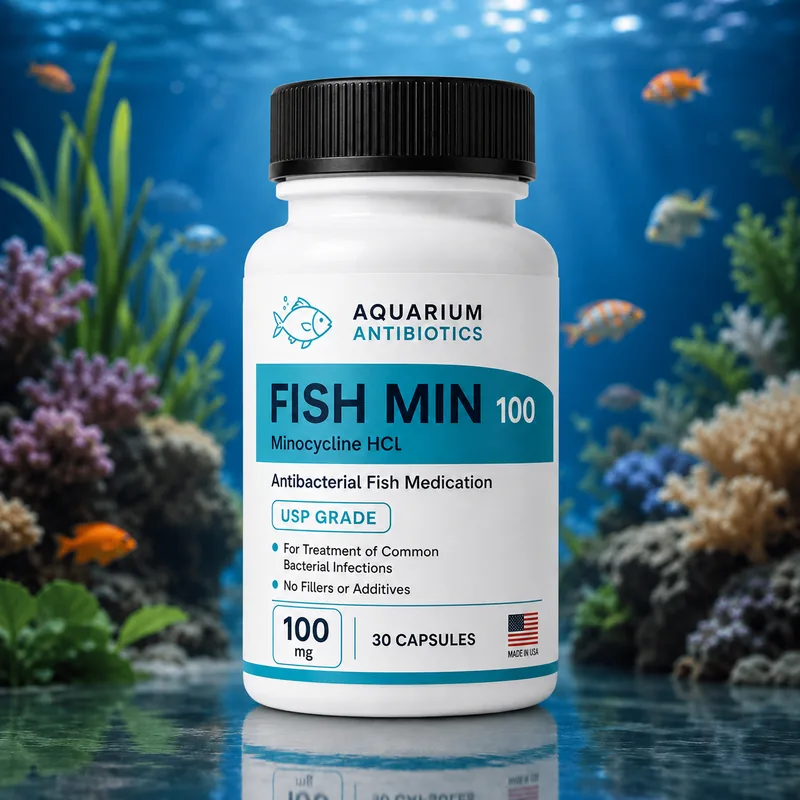
Fish Minocycline 100 mg — 30 Capsules
$79.99
- Free shipping to any US address
- Buy more, save more: 5% off $150+, 10% off $300+, 15% off $500+
- Secure checkout: card, Apple Pay, Google Pay or PayPal
- All sales final · covered if damaged before delivery
- Shipped from the USA with tracking
For ornamental aquarium fish use only. Not for human use or for fish intended for food. Keep out of reach of children. Read the label and consult a veterinarian if you are unsure.
Keeping pet birds? Fish products are labeled for aquarium fish only. See our bird products.
Reviewed by Dr. Kayla Garcia and Dr. Erin Min, veterinarians at Los Feliz Veterinary Clinic
Fish Minocycline 100 mg — 30 Capsules contain minocycline, a tetracycline-class antibiotic. Minocycline is a tetracycline antibiotic that has long been used by aquarists for internal gram-negative infections. It is the active ingredient in some well-known hobby medications.
Spectrum: Broad-spectrum with good activity against many gram-negative bacteria.
Table of contents
- Introduction
- What is Fish Minocycline?
- Common fish diseases Fish Minocycline is used for
- How minocycline works in an aquarium
- Things to know before you treat
- Fish Minocycline dosage and administration guide
- Tank preparation and water parameters
- Step-by-step treatment guide: using Fish Minocycline from start to finish
- Safety, side effects and precautions
- Storage and shelf life
- Fish Minocycline vs other aquarium antibiotics: which one should you choose?
- Compatibility and interactions
- Signs of recovery and when to seek veterinary help
- What Fish Minocycline does not treat
- Who this size suits
- Regulations and responsible use
- Fish Minocycline 100 mg — 30 Capsules FAQ
- Conclusion
- Recommended resources
Introduction
The hardest bacterial infections to treat in aquarium fish are the ones you cannot see. A fish that sits on the bottom with clamped fins, a belly that swells over a few days until the scales stand out, an eye that bulges with no injury to explain it: these are signs that bacteria have reached the organs and the blood, where a medication that only bathes the skin cannot follow. For that picture, keepers have reached for a tetracycline for decades.
Fish Minocycline, usually shortened to Fish Mino, is minocycline in 100mg capsules made for ornamental fish. It is the active ingredient behind some of the hobby's best-known treatments for dropsy, popeye and septicemia, and it is valued because it is absorbed through the gills and circulates inside the fish. This page covers what it is, which conditions it is used for and which it is not, the label dose converted to common tank sizes, the extra preparation tetracyclines need, a start-to-finish treatment walkthrough, safety notes, how it compares with the other antibiotics we sell, and the questions keepers ask most.
Important: Fish Minocycline is made, labeled and sold for ornamental aquarium and pond fish only. It is not for human use and not for fish intended for food. Keep it out of reach of children. Internal infections are hard to judge from outside; if you are unsure about the diagnosis, ask an aquatic veterinarian before treating.
What is Fish Minocycline?
Fish Minocycline, often called Fish Mino, is minocycline in 100mg capsules made for ornamental aquarium fish. Minocycline is a tetracycline-class antibiotic that has been used by aquarists for decades, and it is the active ingredient behind some of the hobby's best-known treatments for internal and systemic infections. It is bacteriostatic: it stops bacteria multiplying and lets the fish's own defences finish the job, which is why clean water and a complete course matter so much. Each capsule is pulled apart and the powder dissolved in aquarium water; the bottle holds 30 capsules.
Where penicillin-class products are mostly used for fin and skin problems, minocycline is the one keepers reach for when the trouble is inside the fish: dropsy, popeye, septicemia and other gram-negative infections that a surface treatment does not reach. It is labeled for aquarium and pond fish only, not for human use and not for fish intended for food.
New to fish medication? Start with Do fish need antibiotics? and the antibiotic comparison, which explains where tetracyclines fit among the other classes.
Product details at a glance
| Active ingredient | Minocycline |
|---|---|
| Drug class | Tetracycline-class antibiotic |
| Available sizes | 30 Capsules |
| Formulation | Pull-apart capsule; the powder dissolves in aquarium water (may tint it yellow) |
| Spectrum of activity | Broad-spectrum with good activity against many gram-negative bacteria. |
| Intended for | Ornamental aquarium fish only |
| Storage conditions | Cool, dry and dark (light- and moisture-sensitive), lid tightly closed; never use expired tetracyclines |
| Shipping | Free, from the USA |
| Sold by | SourceMax Labs LLC |
Common fish diseases Fish Minocycline is used for
Minocycline is usually chosen for infections that have gone systemic or that involve gram-negative bacteria. These are the situations keepers most often describe. Internal problems are hard to judge from outside, so if more than one fish is affected or a fish has stopped eating for days, consult an aquatic veterinarian.
Dropsy and pinecone scales
A swollen body with scales standing out like a pinecone is the sign most keepers associate with minocycline. Dropsy is fluid build-up from organ trouble, often a bacterial infection of the kidney with Aeromonas involved, and it is frequently too advanced by the time it is visible. A systemic tetracycline started early, with pristine water, warmth and sometimes a little salt for species that tolerate it, gives the best chance. The dropsy guide covers what to expect and when to be realistic.
Popeye (exophthalmia)
One or both eyes bulging, sometimes cloudy. One eye is often an injury; both eyes usually mean an internal infection or poor water. When it is bacterial, keepers commonly use minocycline because it reaches the infection through the bloodstream rather than only bathing the surface. See the popeye guide for how to tell injury from infection.
Internal gram-negative infections
Fish that are listless, off their food, hollow-bellied or sitting on the bottom with no external lesion may have an internal infection. Minocycline is water-borne, so it still reaches a fish that will not eat medicated food, which is why it is a common choice for this vague but serious picture.
Septicemia and red streaks
Red streaks in the fins, bleeding under the skin and reddened fin bases point to bacteria in the blood, typically gram-negative. A broad-spectrum tetracycline is one of the two usual choices alongside a fluoroquinolone such as Fish Flox; minocycline suits the keeper who wants a systemic drug that is a little gentler on the fish.
Mouth rot
Eroded, swollen or whitened lips. Mouth lesions can be gram-positive or gram-negative, and a cottony look suggests columnaris; the columnaris vs fungus guide helps. Minocycline's broad spectrum makes it a reasonable choice when the organism is unknown.
Fin rot that did not respond to a penicillin-class drug
If a course of Fish Mox or Fish Ceph did not stop the fins receding, the bacteria are probably gram-negative. Switching to a tetracycline is the usual next step; keepers change families rather than repeating the same one. The fin rot guide explains the sequence.
Bacterial gill disease
Rapid breathing, swollen or pale gill filaments, mucus on the gills and fish hanging at the surface can be bacterial, parasitic or chemical (ammonia and nitrite burns). Test the water first. Because the gills sit in constant contact with medicated water, dissolved minocycline reaches a confirmed bacterial gill infection well; gill flukes, a frequent cause of the same signs, need a different treatment altogether.
How minocycline works in an aquarium
Minocycline binds to the bacterial ribosome and stops bacteria from making the proteins they need to grow and multiply. It is bacteriostatic: it halts the infection and lets the fish's own immune system clear it, which is why complete courses and good water matter more than with a drug that kills outright. It covers a broad range of gram-negative and gram-positive bacteria, and it is unaffected by the enzymes some bacteria use to destroy penicillins.
Tetracyclines bind to calcium and magnesium, so in very hard water or saltwater a little of the dose may be tied up; keepers in hard-water areas usually treat in a hospital tank filled with softer water where practical and never raise the dose above the label to compensate. The drug is also light-sensitive and may tint the water slightly yellow, which is harmless and clears with water changes and carbon after the course.
How it reaches the fish: dissolved in the water, minocycline is absorbed through the gills and skin and circulates in the blood, so it reaches internal organs, the kidney and the tissue behind the eye. That is what sets it apart from treatments that only act on the surface, and why it is used for dropsy and popeye. It has no effect on parasites, fungi or viruses and will not correct the water-quality problem that usually allowed the infection to start. Tetracyclines are hard on the nitrifying bacteria in a filter, so treating in a hospital tank protects the main aquarium's cycle.
Things to know before you treat
- Treat in a hospital tank; tetracyclines can disturb biofilters.
- Not effective against parasites or fungi.
- Fish that have stopped eating may not take medicated food, so water-borne treatment is usually used.
Fish Minocycline dosage and administration guide
Correct dosing matters in both directions. Too little fails to control the infection and selects for resistant bacteria; too much stresses the fish and crashes the filter. Everything below follows the directions printed on the label: one 100mg capsule per 20 gallons of water, repeated every 24 hours for 5 to 10 days. Dose for the actual water volume after subtracting gravel and decor, and never exceed 10 days of continuous treatment.
Directions for use (from the label)
Directions as printed on the product label, for ornamental aquarium fish only. Remove activated carbon from the filter before treatment: carbon absorbs the medication and makes it ineffective.
- Determine your dose: use one 100mg capsule per 20 gallons of aquarium water.
- Dissolve the capsule in a small amount of aquarium water before adding to the tank. Stir until fully dissolved.
- Add directly to your aquarium, pond, or hospital/quarantine tank.
- Repeat every 24 hours for 5–10 days. Do not exceed 10 days of continuous treatment.
- Perform a 25% water change each day before re-dosing to maintain water quality and reduce antibiotic buildup.
Standard dosage chart
| Strength | Water volume | Frequency | Duration |
|---|---|---|---|
| 100mg capsule | 20 gallons | Every 24 hours | 5 to 10 days (never more than 10) |
Dose by tank size
| Water volume | 100mg capsules |
|---|---|
| 20 gallons | 1 capsule |
| 40 gallons | 2 capsules |
| 60 gallons | 3 capsules |
| 100 gallons | 5 capsules |
Capsules can be opened and the powder divided roughly in half for a 10-gallon hospital tank, but filling the tank to a known 20 gallons is more accurate. For ornamental aquarium fish only; not for human use.
Freshwater vs saltwater
Fish Minocycline dissolves and works in both freshwater and marine water, and the label directions are the same for both. Two things differ. Saltwater is rich in calcium and magnesium, which bind a small part of a tetracycline dose, so marine keepers treat in a dedicated quarantine tank rather than the display and keep the water changes regular. And reef displays hold corals, shrimp and snails that were never part of the product's testing, with protein skimmers and UV units that strip or degrade the medication. Skimmer off, UV off, carbon out, and the display untouched.
Tank preparation and water parameters
Skipping preparation is the most common reason an antibiotic course fails, and tetracyclines need two extra steps that other classes do not. Ten minutes before the first dose makes the difference.
- Remove activated carbon and other chemical media (carbon, Purigen, zeolite, resin pads) from every filter. They absorb the minocycline before it can act.
- Turn off UV sterilizers and protein skimmers for the whole course, and dim or switch off the tank light: minocycline degrades in light, and a dark tank also calms a sick fish.
- Do a 25% water change before the first dose to lower the organic load the drug has to compete with, then follow the label's daily 25% change before each re-dose.
- Test and stabilise the water: ammonia and nitrite at zero, nitrate low, temperature steady and appropriate for the species. Dropsy and popeye in particular are often triggered by a water problem that must be fixed for any medication to help.
- Think about hardness. Tetracyclines bind to calcium and magnesium, so in very hard water fill the hospital tank with softer or RO-mixed water where practical. Do not raise the dose above the label to compensate.
- Set up a hospital tank if you can: a bare-bottom 20-gallon tank with a heater, strong aeration and a seasoned sponge filter. It isolates the sick fish, uses a single capsule per dose, and protects the display's plants, invertebrates and biofilter. See how to set up a hospital tank.
Step-by-step treatment guide: using Fish Minocycline from start to finish
The label gives the dose; this is how keepers run the whole course, with the extra steps that tetracyclines need, from the first sign of trouble to the day the fish goes back to the display.
1. Identify the problem
Confirm the signs point to a systemic bacterial infection: swelling with raised scales, bulging eyes, red streaks, a fish that is listless and off its food with no external injury. A swollen belly with white stringy waste suggests internal parasites, white cotton-like tufts suggest fungus and salt-grain dots suggest ich; none responds to minocycline. Test the water: ammonia or nitrite above zero is a problem to fix before, or instead of, medicating.
2. Prepare the treatment environment
Move the fish to the hospital tank, or prepare the display as described above: carbon out, UV and skimmer off, lights off or very low, heater and air stone running, a 25% water change done. A seasoned sponge filter keeps some biological filtration going even as the antibiotic works on it.
3. Measure the water and calculate the dose
Work out the real water volume (length x width x height in inches divided by 231 gives gallons, then subtract for substrate and decor). Use one 100mg capsule per 20 gallons, as the label directs. For an awkward volume, fill the hospital tank to a multiple of 20 gallons rather than guessing a fraction of a capsule.
4. Dissolve and add the medication
Open the capsule into a cup of tank water and stir until the powder has dispersed; undissolved clumps settle on the substrate instead of treating the water. Pour the solution slowly at the filter outflow so it spreads evenly, and do it out of direct light. A slight yellow tint is normal.
5. Run the daily cycle
Every 24 hours, change about 25% of the water as the label directs, matching the temperature, then add the full dose again. This removes degraded medication and the waste a sick fish produces. Dose at the same time each day, keep the light low, and feed lightly, removing anything uneaten so waste does not raise ammonia in a small tank.
6. Monitor and assess
Watch for the swelling to stop increasing, the eye to settle, red streaks to fade, or the fish to begin picking at food, and write it down. Because the drug is bacteriostatic, improvement can be gradual; day 3 to 5 is when most keepers see the turn. If after 5 days of correct dosing nothing has changed, reconsider the diagnosis (see "when to seek veterinary help" below).
7. Complete the course
Keep dosing for the full course even when the fish looks better after a few days; with a bacteriostatic drug the fish's own defences are still finishing the job, and a shortened course lets the infection return. Stop at 10 days at most, as the label says.
8. Recovery after treatment
After the last dose, do a larger water change and put fresh activated carbon back in the filter for a few days to clear the yellow tint and residues. Test ammonia and nitrite daily for a week, since tetracyclines are hard on the biofilter; a bottled nitrifying-bacteria product can help it recover. Keep the fish in quarantine until it has eaten normally for a week, then move it back to the display and watch for relapse.
See water quality during treatment for the daily testing routine.
Safety, side effects and precautions
Used as directed, minocycline is tolerated by most fish, but every antibiotic carries risks a keeper should understand before the first dose, and tetracyclines have a few quirks of their own.
Effects on beneficial bacteria
Minocycline is not selective: it also halts the nitrifying bacteria that process ammonia and nitrite, and tetracyclines are hard on a biofilter. Treat in a hospital tank where you can. If you treat the display, test ammonia and nitrite every day during and after the course, change water when either rises, and expect to re-seed the filter afterward.
Invertebrates, corals and plants
Fish Minocycline is made for fish and has not been tested on shrimp, snails, crabs or corals. It is not a copper or dye product, so plants usually tolerate it, but the yellow tint cuts light and a crashed biofilter harms everything in the tank. Do not treat a community tank that holds sensitive invertebrates; use a dedicated hospital tank.
Scaleless and sensitive species
Loaches, catfish, eels and other scaleless fish, and delicate species generally, can react differently to medications. Watch these fish closely, keep aeration high, and stop and change water if they show distress.
Light sensitivity, water tint and hard water
Minocycline breaks down in light, so a lit tank loses medication faster than the label assumes; keep the hospital tank dim. The water may turn slightly yellow or brown, which is harmless and clears afterward. In very hard water or saltwater, calcium and magnesium bind part of the dose; use softer water in the hospital tank where practical and never increase the dose to compensate. Rarely a fish reacts to the medication itself with heavy mucus or erratic swimming: do an immediate large water change, put carbon back in, and let it settle.
Antibiotic resistance
Underdosing, stopping early, and treating problems that are not bacterial all breed resistant bacteria that no amount of minocycline will touch next time. Dose per label, finish the course, and reserve antibiotics for confirmed or strongly suspected bacterial disease.
Storage and shelf life
Keep the bottle tightly closed in a cool, dry, dark place. Tetracyclines are light-sensitive and absorb moisture, so a bathroom cabinet is too damp, a windowsill too bright and warm, and a closed cupboard away from the tank is right. Keep the capsules in their original labeled bottle so the strength and expiration date stay with them.
Check the expiration date before every course, and never use expired tetracycline products or capsules that have darkened, stuck together or smell unusual: degraded tetracyclines are both weaker than the label dose and, unlike most classes, can be actively harmful. Dispose of expired or unwanted capsules through a pharmacy or household-chemical take-back scheme rather than the bin, and pour unused treated water down the drain, never into ponds or waterways.
Wash hands after handling capsules and after working in medicated water, and prepare the dose out of direct light. Keep the bottle and treated water out of reach of children and other pets.
Fish Minocycline vs other aquarium antibiotics: which one should you choose?
Fish Mino is the usual choice for internal and systemic infections, but it is not the only tool. The table compares the antibiotics we sell so you can match the class to the problem; each product page carries its own full guide.
| Product | Active ingredient | Spectrum | Commonly chosen for | Notes |
|---|---|---|---|---|
| Fish Minocycline | Minocycline | Broad tetracycline; good gram-negative reach | Dropsy, popeye, septicemia, internal infections | Systemic; light-sensitive; harder on biofilters |
| Fish Dox | Doxycycline | Broad tetracycline | The same internal and systemic problems; larger counts | Same family; keepers pick one, never combine them |
| Fish Mox | Amoxicillin | Broad; mainly gram-positive plus some gram-negative | Fin rot, ulcers, wounds, mouth and skin infections | A common first choice for external infections; gentle on fish |
| Fish Flox | Ciprofloxacin | Broad; strong gram-negative | Columnaris, septicemia, aggressive ulcers | Reserve for serious or unresponsive cases |
| Fish Sulfa | Sulfamethoxazole + trimethoprim | Broad combination | Unclear or mixed infections; a backup class | One tablet per 40 gallons suits ponds; sulfa allergy: gloves |
| Fish Zole | Metronidazole | Anaerobic bacteria and protozoa | Internal parasites, hole-in-the-head, bloat with a parasitic cause | Not a general-purpose antibiotic; the usual pick for stringy white waste |
General guidance: use Fish Mino when the problem is inside the fish: dropsy, popeye, septicemia, a listless fish with no external lesion. For fin, skin and mouth problems in an otherwise bright fish, start with Fish Mox or Fish Ceph. For columnaris or an ulcer that grows overnight, a fluoroquinolone is the usual choice. If the swollen belly comes with white stringy waste, it is probably parasites, and Fish Zole is the product to look at. The antibiotic comparison guide goes deeper.
Compatibility and interactions
Mixing aquarium treatments without guidance makes it impossible to tell what is helping and can harm the fish. The general rules keepers follow:
- Fish Minocycline + metronidazole (Fish Zole): the two cover different organisms (aerobic bacteria versus anaerobes and protozoa), and the pairing is sometimes used for a bloated fish whose cause is unclear. Run them together only when a veterinarian or an experienced keeper you trust directs it.
- Fish Minocycline + another antibiotic (Fish Dox, Fish Mox, Fish Flox): avoid. Two tetracyclines together add nothing, and stacking classes hits the biofilter harder and rarely improves the outcome. Switch families when one fails; do not stack them.
- Fish Minocycline + aquarium salt: generally compatible. A low dose of aquarium salt, used as its own label directs and only with salt-tolerant species, is a common support for dropsy and septicemia and does not interfere with the drug.
- Fish Minocycline + water conditioners and buffers: standard dechlorinators are fine to use for the daily water changes. Avoid adding calcium or magnesium supplements and hardness buffers during the course, since they bind the drug, and skip additives with herbal extracts or tea-tree oil.
- Fish Minocycline + antiparasitic or antifungal products: do not combine. Treat one problem at a time, starting with whichever is most immediately dangerous.
- Carbon, Purigen, UV, skimmers and bright light: all remove or degrade the medication. Media out, equipment off and lights low for the whole course.
Signs of recovery and when to seek veterinary help
What improvement looks like
With a susceptible infection the first sign is that things stop getting worse, usually within 2 to 3 days, and the turn is clear by day 5:
- Swelling plateaus and raised scales begin to settle; a bulging eye stops advancing and starts to recede
- Red streaks fade and bleeding under the skin clears
- The fish lifts off the bottom, holds its fins up and swims with the group again
- Appetite returns: a fish that starts picking at food around day 3 to 5 is usually on the way back
- Breathing and gill movement return to normal
When to consult an aquatic veterinarian
Seek professional help when:
- Nothing has changed after 5 days of correct dosing, or the fish is worse
- The fish has not eaten for several days, is breathing hard, or more fish fall ill
- You cannot tell whether the swelling is bacterial, parasitic, dietary or organ failure
- The condition keeps coming back after apparently successful courses
Dropsy that is caught early can resolve, but scales that have been raised for days often indicate damage that will not reverse, and keepers should be prepared for that. If the fish is still declining, consider whether the cause is bacterial at all: bloat from internal parasites or constipation, egg binding, tumors and water poisoning all mimic dropsy, and the bloat and internal parasites guide covers the look-alikes. For a confirmed bacterial infection that has not responded, a fluoroquinolone is the usual next family; a veterinarian can culture a sample and remove the guesswork. The American Veterinary Medical Association and the World Aquatic Veterinary Medical Association both list aquatic practitioners.
What Fish Minocycline does not treat
Minocycline acts only on bacteria. The conditions below need something else, and some of them look very much like the problems it is used for.
- Bloat from internal parasites: a swollen belly with white, stringy waste is usually flagellates, treated with metronidazole (Fish Zole), not an antibiotic.
- Ich, velvet and flukes: external parasites need heat with salt, copper or an antiparasitic; see the ich and velvet guide.
- True fungus: cottony tufts on dead tissue or eggs need an antifungal such as Fish Ketoconazole.
- Constipation, egg binding and overfeeding bloat: dietary problems; fasting and a varied diet, not medication.
- Swim bladder disorder, tumors and old age: no antibiotic helps, and dosing a fish that does not need it only harms the filter.
Who this size suits
Fish Mino comes in one strength, 100mg, and one count, 30 capsules. At one capsule per 20 gallons, a full 10-day course in a 20-gallon hospital tank uses 10 capsules, so one bottle covers three courses in a hospital tank or a single course in a 60-gallon tank. That suits most hobbyists who want a systemic antibiotic on hand for an emergency without a large bottle expiring unused, which matters more with a light- and moisture-sensitive drug than with most.
Keepers who treat larger tanks or ponds regularly often look at Fish Dox, the doxycycline member of the same tetracycline family, which is sold in 30- and 60-tablet counts and is dosed per 10 gallons. The two are closely related and are used for the same problems; keepers pick one, they do not combine them. Orders of $150 or more also qualify for our automatic bulk discount.
Regulations and responsible use
Fish Minocycline is made, labeled and sold for ornamental (non-food) aquarium fish. It has not been evaluated or approved for human use, and it must never be used on fish raised for food, where drug residues are a public-health matter. The U.S. Food and Drug Administration explains the position of ornamental-fish drugs in its article Ornamental Fish Drugs and You.
Rules for animal medicines differ by country and change over time. Outside the United States, access to veterinary antibiotics is often restricted and may require a prescription, and importing them can be unlawful; we ship within the US only. Antibiotic resistance is a shared concern, which is why responsible use matters: diagnose before you dose, use the label amount for the full course, never medicate healthy fish as a precaution, never use expired tetracyclines, and dispose of leftovers properly.
Fish Minocycline 100 mg — 30 Capsules FAQ
How much Fish Minocycline 100 mg — 30 Capsules do I use per gallon of aquarium water?
Determine your dose: use one 100mg capsule per 20 gallons of aquarium water. Repeat every 24 hours for 5–10 days. Do not exceed 10 days of continuous treatment. For ornamental aquarium fish only; not for human use.
What is in Fish Minocycline 100 mg — 30 Capsules?
Fish Minocycline 100 mg — 30 Capsules contain minocycline, a tetracycline-class antibiotic. Available sizes: 30 Capsules. Broad-spectrum with good activity against many gram-negative bacteria.
What is minocycline used for in an aquarium?
Keepers commonly use it for bacterial problems such as dropsy and pinecone scales caused by bacteria, popeye linked to bacterial infection, internal gram-negative infections. It does not treat parasites or true fungus. Our antibiotic comparison guide explains which class suits which problem.
Is Fish Minocycline 100 mg — 30 Capsules for humans?
No. It is labeled for ornamental aquarium fish only and is not for human use or for fish intended for food. Keep out of reach of children.
Can minocycline help with dropsy?
When dropsy is caused by a bacterial infection, a systemic antibiotic such as minocycline is one option keepers use. Dropsy is a symptom of organ trouble, so outcomes vary and early action matters.
What is the correct dose of Fish Minocycline for a 20-gallon tank?
One 100mg capsule per 20 gallons of actual water volume, repeated every 24 hours for 5 to 10 days with a 25% water change before each dose, as the label directs. Measure the real volume: a 20-gallon tank with gravel and decor usually holds 16 to 18 gallons, so fill a bare hospital tank to a measured 20 gallons instead.
How is Fish Minocycline different from Fish Dox?
Both are tetracyclines and work the same way on the same range of bacteria. Minocycline is the long-standing hobby choice for dropsy and internal infections; doxycycline (Fish Dox) is a close relative sold in larger counts and dosed per 10 gallons. Keepers use whichever they have on hand; the two are not used together.
Will Fish Minocycline turn my water yellow?
It may tint the water slightly yellow or brown, especially under light. The color is harmless and clears with water changes and fresh carbon after the course. A strong color change on the first day usually just means the capsule was not fully dispersed.
Does hard water affect minocycline?
Tetracyclines bind to calcium and magnesium, so in very hard water part of the dose may be tied up. Keepers in hard-water areas often treat in a hospital tank filled with softer or RO-mixed water; do not raise the dose above the label to compensate.
Can minocycline save a fish with dropsy?
Sometimes, when it is caught early and the cause is bacterial. Dropsy is a sign of organ failure, and by the time scales stand out the damage is often advanced, so outcomes vary. Clean water, warmth, aeration and a prompt start give the best chance; a fish that has been pineconed for days rarely recovers.
How long does Fish Minocycline take to work?
Because it is bacteriostatic, improvement is gradual. Most keepers see the swelling or eye stop getting worse within 2 to 3 days and the fish begin to eat around day 3 to 5. If nothing has changed after 5 days of correct dosing, re-check the diagnosis and the water before trying another family.
Will it harm my filter bacteria?
Yes, tetracyclines are hard on the nitrifying bacteria in a biofilter. Treat in a hospital tank with its own sponge filter whenever possible. If you treat the main tank, remove carbon, test ammonia and nitrite daily, and expect to re-cycle the tank afterward.
Is it safe for shrimp, snails and plants?
Tetracyclines are not copper or dye products, so they are gentler on invertebrates and plants than many treatments, but they have not been tested on them, they disrupt the filter and they tint the water. Treat in a hospital tank where you can, and keep shrimp out of medicated water.
Can I use it in a saltwater tank?
Yes, the label directions are the same for marine aquariums. Turn off protein skimmers and UV and remove carbon and other chemical media while medicating. Saltwater is high in calcium and magnesium, which can bind some of the drug, so treat in a dedicated quarantine tank rather than the display and keep up the daily water changes.
Why should the lights be off during treatment?
Minocycline breaks down in light, so a lit tank loses medication faster than the label assumes. Keeping the hospital tank dim preserves the dose and also reduces stress on a sick fish.
Can I feed medicated food instead of dosing the water?
Fish with internal infections have usually stopped eating, which is why water-borne treatment is the normal route. If the fish is still eating, some keepers also soak food in dissolved medication, but the label dose for the water is what the product is designed for.
How should I prepare my aquarium before using Fish Minocycline?
Remove activated carbon and other chemical media, switch off UV and skimmers, turn the lights off or very low, do a 25% water change, and make sure ammonia and nitrite read zero with a steady temperature. Use softer water in the hospital tank if yours is very hard. Then dose for the actual water volume.
Can I combine Fish Minocycline with other fish medications?
Avoid combining it with other antibiotics or with antiparasitic and antifungal products unless a veterinarian directs it. It is generally compatible with standard dechlorinators and with aquarium salt used as its own label directs; avoid hardness buffers and mineral supplements during the course.
Is shipping really free?
Yes. Shipping is free to any US address, and tracking is emailed when your order ships.
How do I pay?
Checkout accepts major credit and debit cards and digital wallets such as Apple Pay and Google Pay, through a secure payment page.
Conclusion
Fish Minocycline has stayed in fishkeepers' medicine cabinets for a simple reason: when an infection has moved inside the fish, into the blood, the kidney or the tissue behind the eye, a tetracycline that circulates through the body is what reaches it. Used responsibly, with an early start, the label dose for the actual water volume, a dim and well-aerated hospital tank, and the full course, it gives a fish with dropsy, popeye or septicemia the best chance the hobby can offer.
It is still a tool, not a substitute for husbandry, and with internal infections the clock matters more than the drug. Stable water, quarantine for new arrivals, sensible stocking and a varied diet prevent most of the infections an antibiotic would otherwise have to treat, and a keeper who knows their fish spots a listless one days before the scales rise. Keep a bottle on hand so you can act on the first day you see a problem, and keep the water clean so that day comes rarely.
Recommended resources
On this site
- Dropsy in Fish: Signs, Causes and Treatment Options
- Popeye (Pop-Eye) in Fish: Causes and Treatment
- Bloat and Internal Parasites in Fish
- Fish Antibiotics Compared: Which Class Treats What
- How to Set Up a Fish Hospital Tank
- Water Quality During Fish Treatment
- Fish Dox (doxycycline): the related tetracycline
- Fish Zole (metronidazole): for bloat with a parasitic cause
External resources
- FDA: Ornamental Fish Drugs and You
- American Veterinary Medical Association
- World Aquatic Veterinary Medical Association
- Merck Veterinary Manual
This page is educational and does not replace veterinary advice. Fish Minocycline and every product discussed here are for ornamental aquarium fish only; they are not for human use and not for fish intended for food. Consult a qualified aquatic veterinarian for diagnosis and treatment decisions.
You may also need


