

FREE SHIPPING
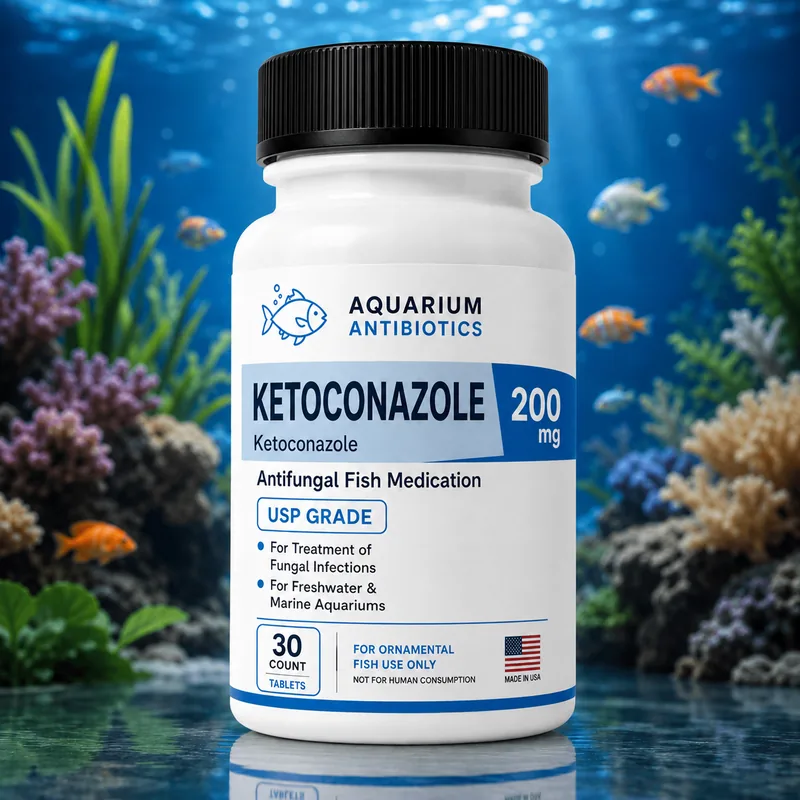
Fish Ketoconazole 200mg 30 Tablets
$102.80
- Free shipping to any US address
- Buy more, save more: 5% off $150+, 10% off $300+, 15% off $500+
- Secure checkout: card, Apple Pay, Google Pay or PayPal
- All sales final · covered if damaged before delivery
- Shipped from the USA with tracking
For ornamental aquarium fish use only. Not for human use or for fish intended for food. Keep out of reach of children. Read the label and consult a veterinarian if you are unsure.
Keeping pet birds? Fish products are labeled for aquarium fish only. See our bird products.
Reviewed by Dr. Kayla Garcia and Dr. Erin Min, veterinarians at Los Feliz Veterinary Clinic
Fish Ketoconazole 200mg 30 Tablets contain ketoconazole, a azole antifungal. Ketoconazole is an azole antifungal that disrupts the fungal cell membrane. It is used for fungal infections of the skin and body.
Spectrum: Fungi (not bacteria or parasites).
Table of contents
- Introduction
- What is Fish Ketoconazole 200mg?
- Common fish conditions Fish Ketoconazole is used for
- How ketoconazole works in an aquarium
- Things to know before you treat
- Fish Ketoconazole dosage and administration guide
- Tank preparation and water parameters
- Step-by-step treatment guide: using Fish Ketoconazole from start to finish
- Safety, side effects and precautions
- Storage and shelf life
- Fish Ketoconazole vs other aquarium treatments: which one should you choose?
- Compatibility and interactions
- Signs of recovery and when to seek veterinary help
- What Fish Ketoconazole does not treat
- Who this size suits
- Regulations and responsible use
- Fish Ketoconazole 200mg 30 Tablets FAQ
- Conclusion
- Recommended resources
Introduction
Fungus is the aquarium problem keepers most often misname. A fluffy white tuft on a fish's flank looks dramatic, and the instinct is to reach for an antifungal, but half the time the "fungus" is columnaris, a bacterial infection, and the other half it is a true water mold growing on tissue that something else, an injury, cold water, a parasite or an earlier infection, had already damaged. Getting that distinction right is the whole game, because a true fungal infection clears readily with the right product while the same product does nothing for columnaris and the delay can be fatal.
Fish Ketoconazole 200mg, often called Fish Keto, is ketoconazole in 200mg tablets made for ornamental aquarium fish. It is an azole antifungal, not an antibiotic, and each tablet treats 50 gallons on the label, which makes it the large-system option in our antifungal pair. This page covers everything a keeper needs before dosing it: what Fish Keto is, which fungal conditions it is used for and which look-alikes it is not, the label dose converted to common system sizes, how to prepare the tank, a start-to-finish treatment walkthrough, safety notes, how it compares with the other treatments we sell, and the questions keepers ask most.
Important: Fish Ketoconazole is made, labeled and sold for ornamental aquarium and pond fish only. It is not for human use and not for fish intended for food. Keep it out of reach of children. If you are unsure whether the growth is fungus or columnaris, read our comparison guide or ask an aquatic veterinarian before treating.
What is Fish Ketoconazole 200mg?
Fish Ketoconazole 200mg, often called Fish Keto, is ketoconazole in 200mg tablets made for ornamental aquarium fish. Ketoconazole is an azole antifungal, not an antibiotic: it acts on fungi and has no effect on bacteria or parasites. It is used for true fungal infections, the fluffy, cotton-like tufts of water mold that grow on damaged tissue, dead eggs and healing wounds, and it works by starving the fungus of a building block its cell membrane needs.
Each tablet treats 50 gallons of water on the label, which makes this a large-volume product: the practical choice for ponds, sumps, big display tanks and breeding systems. The tablet is dissolved in a cup of tank water and spread across the surface so the medication bathes the affected tissue directly. It is sold here in a 30-tablet bottle, labeled for aquarium and pond fish only. It is not for human use and not for fish intended for food. Its relative, the 100mg Aquarium Fluconazole tablet, is the same family of drug sized for a single small tank.
Before buying any antifungal, be sure the problem is actually fungus. The most common mistake in the hobby is treating columnaris, a bacterial infection that also looks white and cottony, with an antifungal. Read columnaris vs fungus first: it shows the two side by side.
Product details at a glance
| Active ingredient | Ketoconazole |
|---|---|
| Drug class | Azole antifungal |
| Available sizes | 30 Tablets |
| Formulation | Tablet; dissolve in aquarium water before adding |
| Spectrum of activity | Fungi (not bacteria or parasites). |
| Intended for | Ornamental aquarium fish only |
| Storage conditions | Cool, dry, out of sunlight, lid tightly closed; check the expiration date |
| Shipping | Free, from the USA |
| Sold by | SourceMax Labs LLC |
Common fish conditions Fish Ketoconazole is used for
Fungal infections in fish are almost always secondary: the fungus settles on tissue that was already damaged by injury, poor water, cold, parasites or an earlier bacterial infection. Below are the situations keepers use ketoconazole for, and the look-alike that needs something else. If the growth is spreading fast or several fish are affected, ask an aquatic veterinarian.
True fungal infections on the body and fins
Fluffy, raised tufts that look like cotton wool or mold, usually white to grey, sometimes tinged brown or green by debris. Under a magnifying glass the growth has fine filaments standing out from the tissue, and it spreads slowly over days rather than hours. This is the classic Saprolegnia-type water mold, and it is what ketoconazole is used for. It almost always starts on a spot that was already damaged.
Fungus on eggs
Infertile eggs turn white and fuzzy within a day or two, and the fungus can spread to the fertile eggs beside them. Breeders use an antifungal in the hatching tank to protect the clutch while it develops, alongside removing fungused eggs promptly and keeping strong aeration over the eggs. At one tablet per 50 gallons, a large hatching system is where this strength makes sense.
Fungus on wounds after injury
A scrape from decor, a bite, or a patch of missing scales is a landing site for fungal spores that are always present in aquarium water. If a wound grows a fluffy coat while healing, ketoconazole is used to clear it so the skin can close. Clean water is the other half of the treatment: the antifungal removes the growth, the water lets the tissue heal.
Fungus following fin rot
Fins that have been eroded by fin rot often grow fungal tufts on the dead edges once the bacterial infection is under control. Keepers treat the fungus after, not during, the antibiotic course, with a water change between, so the two medications are never mixed in one tank.
Fungus on fish weakened by cold, stress or parasites
Fish kept too cool for their species, bullied fish, new arrivals and fish carrying an external parasite such as ich are the usual fungus patients. The antifungal clears the growth, but unless the temperature, stress or parasite is dealt with it will return. See the ich and velvet guide if you also see white dots.
Fungus in fry tanks and on uneaten food
In a fry tank, fungus takes hold on dead fry, uneaten food and debris before it reaches live fish. Breeders running large grow-out systems use ketoconazole to knock the growth back while they correct the cause: overfeeding, weak flow or a missed water change. Siphoning the debris matters as much as the medication.
Cotton-like patches that are really columnaris
A flat, pale patch, a greyish saddle across the back, or white erosion around the mouth that spreads within a day or two is usually columnaris, a gram-negative bacterial infection. An antifungal will not touch it, and the delay can be fatal. Columnaris is commonly treated with a fluoroquinolone such as Fish Flox; the columnaris vs fungus guide shows how to tell the two apart before you dose.
How ketoconazole works in an aquarium
Ketoconazole blocks an enzyme fungi need to make ergosterol, the main building block of their cell membrane. Without it the membrane leaks, and the fungus stops growing and dies back. Bacteria and fish cells do not use ergosterol, which is why an azole antifungal does nothing against a bacterial infection and why it is comparatively gentle on the fish itself. It is fungistatic at hobby concentrations: it halts the growth so the fish's own defences and clean water can finish the job.
The dead tufts do not vanish overnight. The fungus stops spreading first, then the mat loosens and sloughs away as the tissue beneath heals, usually over the second half of the course. Ketoconazole has no effect on parasites, viruses, bacteria or the water-quality problem that usually allowed the fungus to take hold, so those need attention alongside the course.
How it reaches the fish: dissolved in the water, the drug bathes the affected tissue directly, which suits surface growth on skin, fins and eggs well, and some is absorbed through the gills and skin. Antifungals are less disruptive to filter bacteria than antibiotics, but treating in a hospital tank is still the usual practice: it uses far less medication, keeps other fish and invertebrates out of treated water, and makes daily water changes simple.
Things to know before you treat
- Many cotton-like growths on fish are actually columnaris, a bacterial infection, not fungus. See our comparison guide before choosing a treatment.
- Not effective against bacteria or parasites.
- Treat in a hospital tank.
Fish Ketoconazole dosage and administration guide
Correct dosing matters in both directions. Too little leaves the fungus growing; too much stresses the fish and wastes a large-volume tablet. Everything below follows the directions printed on the label. Dose for the actual water volume after gravel and decor (a "125-gallon" tank often holds 100 gallons), and never exceed 10 days of continuous treatment.
Directions for use (from the label)
Directions as printed on the product label, for ornamental aquarium fish only. Remove activated carbon from the filter before treatment: carbon absorbs the medication and makes it ineffective.
- Determine your dose: use one 200mg tablet per 50 gallons of aquarium water.
- Dissolve the tablet in a small amount of aquarium water before adding to the tank. Stir until fully dissolved.
- Add directly to your aquarium, pond, or hospital/quarantine tank.
- Repeat every 24 hours for 5–10 days. Do not exceed 10 days of continuous treatment.
- Perform a 25% water change each day before re-dosing to maintain water quality and reduce medication buildup.
Standard dosage chart
| Strength | Water volume | Frequency | Duration |
|---|---|---|---|
| 200mg tablet | 50 gallons | Every 24 hours | 5 to 10 days (never more than 10) |
Dose by tank size
| Water volume | 200mg tablets |
|---|---|
| 50 gallons | 1 tablet |
| 100 gallons | 2 tablets |
| 150 gallons | 3 tablets |
| 250 gallons | 5 tablets |
Because one tablet treats 50 gallons, this product is sized for large tanks, sumps and ponds. Tablets are not easily split accurately, so for a hospital tank under 50 gallons keepers more often use the 100mg fluconazole tablet, which treats the same 50 gallons at a lower strength and cost, or dissolve one tablet in a measured volume of water and add only the share that matches the tank. For ornamental aquarium fish only; not for human use.
Freshwater vs saltwater
Fish Ketoconazole dissolves and works in both freshwater and marine water, and the label directions are the same for both. True water molds are far more common in freshwater, so most marine "fungus" is something else; be especially careful with the diagnosis in a reef system. Marine displays also hold corals and invertebrates that were never part of the product's testing, and run protein skimmers and UV units that strip medication from the water. Treat marine fish in a bare quarantine tank with the skimmer off and the carbon out.
Tank preparation and water parameters
Skipping preparation is the most common reason a treatment course fails, and with fungus the preparation is half the treatment: the growth only lives on tissue that bad water or injury has already weakened.
- Remove activated carbon and other chemical media (carbon, resins, zeolite, chemical pads) from every filter. They absorb the ketoconazole before it can act.
- Turn off UV sterilizers and protein skimmers for the duration of the course; both reduce the medication in the water column.
- Do a 25% water change before the first dose, siphoning out debris, uneaten food and any fungused eggs or dead fry, then follow the label's daily 25% change before each re-dose.
- Test and stabilise the water: ammonia and nitrite at zero, nitrate low. Ammonia burns damage skin and fins, and damaged tissue is where fungus grows.
- Check the temperature. Water molds thrive on fish kept too cold for their species. Bring the tank to the normal range for the fish and hold it steady; a swing mid-course adds stress.
- Set up a hospital tank if you can: a bare-bottom tank with a heater, an air stone and a seasoned sponge filter, sized so the dose is easy to measure. It isolates the fish, uses a fraction of the medication, and protects the display's plants, invertebrates and biofilter. See how to set up a hospital tank.
Step-by-step treatment guide: using Fish Ketoconazole from start to finish
The label gives the dose; this is how keepers run the whole course, from the first tuft to the day the fish goes back to the display.
1. Identify the problem
Confirm it is fungus: raised, fluffy filaments standing out from damaged tissue, spreading slowly. Flat, pale or grey patches that spread within a day or two are more likely columnaris and need an antibiotic instead; salt-grain dots are ich. Then find what let the fungus in, since an injury, cold water, a parasite or a bacterial infection usually came first.
2. Prepare the treatment environment
Move the fish to the hospital tank, or prepare the display as described above: carbon out, UV and skimmer off, heater and air stone running, debris siphoned, a 25% water change done. A seasoned sponge filter keeps biological filtration going.
3. Measure the water and calculate the dose
Work out the real water volume (length × width × height in inches ÷ 231 gives gallons, then subtract for substrate and decor). Use one 200mg tablet per 50 gallons, as the label directs. For a smaller tank, dissolve a tablet in a measured container of tank water and add the share that matches the volume, discarding the rest.
4. Dissolve and add the medication
Dissolve the tablet completely in a cup of tank water and stir; a tablet dropped in whole sits on the bottom and releases unevenly. Pour the solution slowly across the surface or near the filter outflow so it spreads.
5. Run the daily cycle
Every 24 hours, change about 25% of the water as the label directs, siphoning any sloughed material, then add the full dose again. Dose at the same time each day, keep the temperature constant, and feed lightly, removing anything uneaten so fungus has nothing else to grow on.
6. Monitor and assess
Watch the tufts daily under good light and write it down. They should stop enlarging within 2 to 3 days and no new patches should appear; then the mat loosens and sloughs off. If after 4 to 5 days the patch is spreading fast or has turned into a flat grey erosion, it is probably not fungus (see "when to switch" below).
7. Complete the course
Keep dosing for the full course even when the fish looks clear after a few days; fungus that was only knocked back returns from the spores left behind. Stop at 10 days at most, as the label says.
8. Recovery after treatment
After the last dose, do a larger water change and put fresh activated carbon back in the filter for a few days to clear residues. Keep the fish in quarantine until the skin has closed and it has eaten normally for a week, fix whatever let the fungus in, then move it back to the display and watch for relapse.
See water quality during treatment for the daily testing routine.
Safety, side effects and precautions
Used as directed, ketoconazole is one of the gentler aquarium treatments, but every medication carries risks a keeper should understand before the first dose.
Effects on beneficial bacteria
Antifungals disturb the nitrifying bacteria less than antibiotics do, but any medication course in a display tank can unsettle the filter. Treat in a hospital tank where you can. If you treat the display, test ammonia and nitrite every day during and after the course and change water when either rises.
Invertebrates, corals and plants
Fish Ketoconazole is made for fish and has not been tested on shrimp, snails, crabs or corals. Plants usually tolerate it. Do not treat a community tank that holds sensitive invertebrates; use a dedicated hospital tank.
Scaleless and sensitive species
Loaches, catfish, eels and other scaleless fish, and delicate species generally, can react differently to medications. Ketoconazole is usually tolerated, but watch these fish closely, keep aeration high, and stop and change water if they show distress.
Signs of intolerance
Rarely a fish reacts to a medication rather than to its illness: heavy mucus, darting or erratic swimming, or gill movement that speeds up after a dose. If that happens, do an immediate large water change, put carbon back in, and let the fish settle before deciding what to do next.
Treating the wrong problem
The main risk with an antifungal is not the drug but the misdiagnosis. Columnaris treated as fungus can kill a fish in days, and antibiotics withheld while an antifungal runs are days lost. If the growth is flat, fast or affecting several fish, confirm the diagnosis before continuing.
Storage and shelf life
Keep the bottle tightly closed in a cool, dry place away from sunlight, heat and humidity; a bathroom cabinet is too damp and a windowsill too warm. Tablets that have taken up moisture soften, crumble and lose strength, and warmth speeds that loss. Keep the tablets in their original labeled bottle so the strength and expiration date stay with them.
Check the expiration date on the label before each course and do not use tablets past it: an expired tablet may deliver less than the label dose. A dissolved tablet should be used the same day, not stored. Dispose of expired or unwanted tablets through a pharmacy or household-chemical take-back scheme rather than the bin, and pour unused treated water down the drain, never into ponds or waterways.
Wash hands after dosing. Keep the bottle and medicated water out of reach of children and other pets.
Fish Ketoconazole vs other aquarium treatments: which one should you choose?
Fish Ketoconazole is one of two antifungals we sell, and the look-alikes it is confused with are bacterial. The table sets it beside the products keepers weigh it against so you can match the treatment to the problem; each product page carries its own full guide.
| Product | Active ingredient | Spectrum | Commonly chosen for | Notes |
|---|---|---|---|---|
| Fish Ketoconazole | Ketoconazole | Fungi only (not bacteria or parasites) | True fungus on body, fins, wounds and eggs in large systems | Azole antifungal; 200mg treats 50 gallons; sized for ponds and big tanks |
| Aquarium Fluconazole | Fluconazole | Fungi only | The same fungal conditions in a single small tank | Same azole family; 100mg treats 50 gallons; lower cost per course |
| Fish Flox | Ciprofloxacin | Broad; strong gram-negative | Columnaris, the main fungus look-alike; septicemia | What a cottony patch that spreads fast usually needs |
| Fish Mox | Amoxicillin | Broad; mainly gram-positive | Fin rot, ulcers and wounds, often the infection that preceded the fungus | Run the antibiotic course first, then the antifungal |
| Fish Zole | Metronidazole | Anaerobic bacteria and protozoa | Internal parasites, hole-in-the-head | Not an antifungal |
| Fish Dox | Doxycycline | Broad tetracycline | Internal and systemic bacterial infections | Not an antifungal |
General guidance: if the growth is raised, fluffy and slow, use an antifungal: Fish Ketoconazole for a pond, sump or large tank, Aquarium Fluconazole for a small hospital tank. If the patch is flat, fast or saddle-shaped, treat it as columnaris with Fish Flox. If fungus appeared on fins or skin that an infection had already damaged, finish the antibiotic course first and run the antifungal afterward. The columnaris vs fungus guide and the antibiotic comparison go deeper.
Compatibility and interactions
Mixing aquarium treatments without guidance makes it impossible to tell what is helping and can harm the fish. The general rules keepers follow:
- Fish Ketoconazole + an antibiotic (Fish Mox, Fish Flox, Fish Dox): do not run them together. If a fish has both a bacterial infection and fungus on the damaged tissue, the usual order is the antibiotic course first, then a water change, then the antifungal.
- Fish Ketoconazole + Aquarium Fluconazole: never together. They are the same family of drug; choose the strength that suits the tank volume and use one.
- Fish Ketoconazole + an ich or parasite treatment: treat one problem at a time. If a parasite is the reason the fungus took hold, the parasite is usually the more urgent problem; clear it, change water, then treat the fungus.
- Fish Ketoconazole + aquarium salt: generally compatible. A low dose of aquarium salt, used as its own label directs and only with salt-tolerant species, is a traditional support against water molds and does not interfere with ketoconazole.
- Fish Ketoconazole + water conditioners: standard dechlorinators are fine to use for the daily water changes. Skip additives with herbal extracts, tea-tree oil or "slime coat" formulas during the course; their effect on the medication is unknown.
- Carbon, chemical resins, UV, skimmers: all remove or degrade the medication. Out or off for the whole course.
Signs of recovery and when to seek veterinary help
What improvement looks like
With a true fungal infection the change is visible within 2 to 3 days, and clear by the second half of the course:
- The tufts stop enlarging and no new patches appear
- The mat thins, loosens and sloughs away, leaving pink or pale healing tissue underneath
- Appetite and activity return once the irritation of the growth is gone
- Fungused eggs stop spreading to their neighbours and the clutch develops normally
- New fin and skin tissue grows back over the following weeks with clean water alone
When to consult an aquatic veterinarian
Seek professional help when:
- The patch is spreading fast after 4 to 5 days, or has turned into a flat grey or white erosion
- Several fish are developing the same growth at once
- The fungus clears and then returns after every course
- The fish is breathing hard, has stopped eating, or is worse at any point
A fast-spreading flat patch behaves exactly like columnaris, which is bacterial and needs an antibiotic; the columnaris vs fungus guide and the antibiotic comparison explain the next step. Fungus that keeps returning means the underlying cause, usually water quality, cold, injury or a parasite, has not been fixed. A veterinarian can examine a scraping under a microscope and tell fungus from bacteria in minutes; the American Veterinary Medical Association and the World Aquatic Veterinary Medical Association both list aquatic practitioners.
What Fish Ketoconazole does not treat
Ketoconazole acts only on fungi. Using it on anything else wastes days while the real problem gets worse.
- Bacterial infections of any kind: fin rot, ulcers, septicemia, dropsy, popeye. These need an antibiotic such as Fish Mox or Fish Dox.
- Columnaris, the most common fungus look-alike. It is bacterial and is usually treated with Fish Flox.
- Ich, velvet and other external parasites: see the ich and velvet guide.
- Internal parasites, bloat and hole-in-the-head: usually treated with metronidazole (Fish Zole); see bloat and internal parasites.
- Water-chemistry injuries and viral lumps, which no medication will change.
Who this size suits
Fish Ketoconazole comes in one size, 30 tablets of 200mg. At one tablet per 50 gallons, a full 10-day course on a 100-gallon tank uses 20 tablets, so one bottle covers a course or two on a large system. That makes it the practical choice for pond keepers, breeders running big hatching or grow-out systems, and keepers of large tanks or sumps, where a lower-strength tablet would mean handling many more pieces per dose.
For a 10- or 20-gallon hospital tank the dose is a fraction of a tablet, which is awkward to measure. Keepers treating a single small tank are usually better served by the 100mg fluconazole tablet, a related azole antifungal with the same 50-gallon label ratio at a lower cost per course. Orders of $150 or more qualify for our automatic bulk discount.
Regulations and responsible use
Fish Ketoconazole is made, labeled and sold for ornamental (non-food) aquarium fish. It has not been evaluated or approved for human use, and it must never be used on fish raised for food, where drug residues are a public-health matter. The U.S. Food and Drug Administration explains the position of ornamental-fish drugs in its article Ornamental Fish Drugs and You.
Rules for animal medicines differ by country and change over time. Outside the United States, access to veterinary medicines is often restricted, and importing them can be unlawful; we ship within the US only. Responsible use matters with antifungals as much as with antibiotics: confirm the growth is fungus before you dose, use the label amount for the full course, fix the injury or water problem that let the fungus in, and dispose of leftovers properly.
Fish Ketoconazole 200mg 30 Tablets FAQ
How much Fish Ketoconazole 200mg 30 Tablets do I use per gallon of aquarium water?
Determine your dose: use one 200mg tablet per 50 gallons of aquarium water. Repeat every 24 hours for 5–10 days. Do not exceed 10 days of continuous treatment. For ornamental aquarium fish only; not for human use.
What is in Fish Ketoconazole 200mg 30 Tablets?
Fish Ketoconazole 200mg 30 Tablets contain ketoconazole, a azole antifungal. Available sizes: 30 Tablets. Fungi (not bacteria or parasites).
What is ketoconazole used for in an aquarium?
Keepers commonly use it for bacterial problems such as confirmed fungal infections, fungal growth on wounds or eggs. It does not treat parasites or true fungus. Our antibiotic comparison guide explains which class suits which problem.
Is Fish Ketoconazole 200mg 30 Tablets for humans?
No. It is labeled for ornamental aquarium fish only and is not for human use or for fish intended for food. Keep out of reach of children.
How do I know if it is fungus or columnaris?
True fungus is fluffy and cotton-like and usually starts on damaged tissue or dead eggs. Columnaris is bacterial, often looks like a pale saddle or frayed patch, and spreads quickly. Our guide compares them side by side.
What is the correct dose of Fish Ketoconazole for a 100-gallon tank?
Two 200mg tablets per 100 gallons of actual water volume, repeated every 24 hours for 5 to 10 days with a 25% water change before each dose, as the label directs. The label ratio is one tablet per 50 gallons; measure the real volume after gravel and decor.
How do I know if my fish has fungus or columnaris?
True fungus is raised, fluffy and cotton-like, with fine filaments standing out from damaged tissue, and it spreads slowly. Columnaris is flat, pale or grey, often saddle-shaped across the back or around the mouth, and spreads within a day or two. Fungus needs an antifungal; columnaris needs an antibiotic. Our columnaris vs fungus guide shows both.
How long does Fish Ketoconazole take to work?
The tufts usually stop enlarging within 2 to 3 days and then loosen and slough away over the rest of the course. If a patch is spreading fast after 4 to 5 days, it is probably not fungus.
Can I use Fish Ketoconazole with an antibiotic at the same time?
Keepers treat one problem at a time. If a fish has both a bacterial infection and fungus on the damaged tissue, the usual order is the antibiotic course first, then the antifungal, with a water change between. Mixing medications stresses the fish and makes it impossible to tell which one is working.
Does Fish Ketoconazole treat fungus on eggs?
It is used in hatching tanks for that purpose. Remove white, fuzzy infertile eggs promptly, keep strong aeration over the clutch, and follow the label dose for the hatching tank's water volume; for a small hatching tank, dissolve a tablet in a measured volume and add only the matching share.
Why does the fungus keep coming back?
Fungus only grows on tissue that is already damaged or on fish that are run down. If it returns after a course, look for the cause: poor water quality, a low temperature, an untreated parasite, bullying, or sharp decor. Fix that and the antifungal will not be needed again.
Is ketoconazole safe for plants, shrimp and snails?
Azole antifungals are not known for harming plants, but they have not been tested on invertebrates, which are best kept out of any medicated tank. Treating in a hospital tank avoids the question and uses far less medication.
Can I use Fish Ketoconazole in a saltwater aquarium?
Yes. The label directions are the same for freshwater and marine tanks, though true water molds are much less common in marine systems, so confirm the diagnosis. Remove carbon and skimmer media while medicating and keep protein skimmers and UV off, as they strip medication from the water.
How should I prepare my tank before using Fish Ketoconazole?
Remove activated carbon and other chemical media, switch off UV and skimmers, siphon out debris and any fungused eggs, do a 25% water change, bring the temperature to the normal range for the species, and make sure ammonia and nitrite read zero. Set up a hospital tank if you can. Then dose for the actual water volume.
Should I remove activated carbon when using Fish Ketoconazole?
Yes. Activated carbon, chemical resins and similar media absorb medication and make the dose ineffective. Take them out before the first dose and put fresh carbon back after the course to clear residues.
Can I feed the fish during treatment?
Yes, lightly. A fish that is eating is recovering. Feed small amounts once a day and remove uneaten food promptly, because leftover food is exactly what fungus grows on and it raises ammonia in a small tank.
What should I do if Fish Ketoconazole does not improve my fish?
If the growth is still spreading after 4 to 5 days of correct dosing, stop and reconsider. The patch is probably columnaris or another bacterial infection and needs an antibiotic, or the underlying injury, cold or parasite has not been addressed. An aquatic veterinarian can examine a scraping and settle the question in minutes.
What is the difference between Fish Ketoconazole and Aquarium Fluconazole?
Both are azole antifungals used for the same fungal infections and both treat 50 gallons per tablet on the label. Fish Ketoconazole is the 200mg tablet, better suited to ponds and large systems; the 100mg fluconazole tablet costs less per course and is the more common choice for a single small tank.
Is shipping really free?
Yes. Shipping is free to any US address, and tracking is emailed when your order ships.
How do I pay?
Checkout accepts major credit and debit cards and digital wallets such as Apple Pay and Google Pay, through a secure payment page.
Conclusion
True fungal infections are among the more forgiving problems in fishkeeping once they are correctly identified: the growth is on the surface, the fish is usually otherwise sound, and an azole antifungal such as Fish Ketoconazole halts it within days. Used responsibly, with a careful look at the growth, the label dose for the actual water volume, a full course, and a prepared hospital tank, it clears the tufts and lets the skin, fins or eggs beneath recover. For ponds, sumps and large systems the 200mg tablet keeps the number of pieces per dose manageable.
It is still a tool, not a substitute for husbandry. Fungus is a symptom of something else: an injury, water that slipped, a tank kept too cold, a parasite or a bacterial infection that came first. Fix that cause, keep the water clean, quarantine new arrivals and remove debris and dead eggs promptly, and the antifungal stays on the shelf where it belongs.
Recommended resources
On this site
- Columnaris vs Fungus in Fish: How to Tell the Difference
- Fin Rot in Fish: Causes, Symptoms and Treatment
- How to Set Up a Fish Hospital Tank
- Water Quality During Fish Treatment
- Ich and Velvet in Fish: Identification and Treatment
- Fish Antibiotics Compared: Which Class Treats What
- Aquarium Fluconazole (100mg): the small-tank antifungal
- Fish Flox (ciprofloxacin): for columnaris, the fungus look-alike
External resources
- FDA: Ornamental Fish Drugs and You
- American Veterinary Medical Association
- World Aquatic Veterinary Medical Association
- Merck Veterinary Manual
This page is educational and does not replace veterinary advice. Fish Ketoconazole and every product discussed here are for ornamental aquarium fish only; they are not for human use and not for fish intended for food. Consult a qualified aquatic veterinarian for diagnosis and treatment decisions.
You may also need